Stacks and Queues
Stacks and queues are linear data structures. The difference is not the shape of the data, but the rule for which item can leave next.
You can read this note directly without first reading the hub. The only Python ideas assumed are lists, indexes, simple classes, and methods. If those are unfamiliar, read Data Types and Collections first.
The Big Idea
A stack or queue is not just “a list of values”. It is a list of values plus a rule about access.
| Structure | Access rule | Everyday model | Next item removed |
|---|---|---|---|
| stack | last in, first out | undo history | newest item |
| queue | first in, first out | service line | oldest item |
This access rule is the reason the structure exists. If any item can be removed freely from the middle, the structure is no longer being used as a pure stack or queue.
A good way to study both structures is to ask four questions:
- Where is a new item added?
- Where is the next item removed?
- Which pointer or index identifies that position?
- What happens if the structure is empty or full?
These questions are often more useful than memorising a definition alone.
Abstract Operation Versus Implementation
A stack or queue is an abstract data type, or ADT. The ADT tells us what operations are allowed and what behaviour they must have.
For example, a stack ADT supports push() and pop(). This does not force the stack to be stored in one particular way. The same stack behaviour can be implemented using:
- a Python list;
- a fixed-size array;
- linked nodes.
Similarly, a queue ADT can be implemented using an array, a circular array, or linked nodes.
In exam questions, always check whether the question is asking about the ADT behaviour or the implementation details.
In pseudocode, <- means assignment: store the value on the right into the variable or field on the left.
| Question focus | What to think about |
|---|---|
| ADT behaviour | Which item is allowed to leave next? |
| Python list implementation | Which list method is being used? |
| fixed-size array implementation | Where are top, front, and rear? |
| circular queue implementation | Does a pointer wrap around using modulo? |
Stack: Last In, First Out
A stack follows LIFO order: last in, first out.
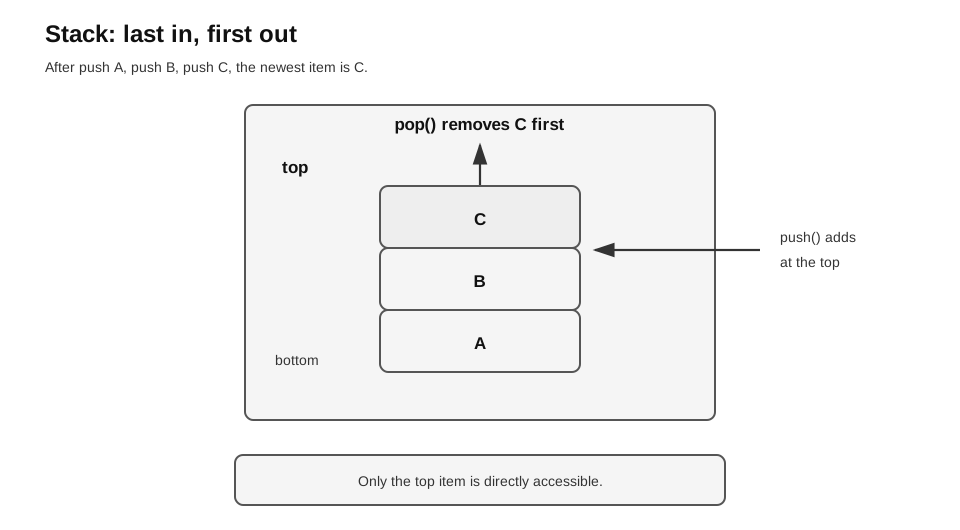
Caption: A stack only exposes the top item: after pushing A, B, then C, pop() removes C first.
Example trace:
| Operation | Stack after operation | Return value |
|---|---|---|
| start | [] | |
push("A") | ["A"] | |
push("B") | ["A", "B"] | |
push("C") | ["A", "B", "C"] | |
pop() | ["A", "B"] | "C" |
The invariant is that the top item is always the next item to be removed.
An invariant is a rule that remains true after every valid operation. For a stack, the invariant is simple:
Only the top item is directly removed by
pop().
Simple Python Stack
stack = []

stack.append("A")
stack.append("B")
stack.append("C")

top = stack[-1]
removed = stack.pop()
In this simple Python version:
append()acts as push;pop()removes from the top;stack[-1]peeks at the top.
Exam questions may use abstract operations such as push() and pop() even if Python code uses list methods.
Stack Using a Fixed-Size Array
A stack may also be implemented using a fixed-size array. In that case, the array has a fixed capacity, and a top index records where the current top item is.
One common convention is:
top = -1means the stack is empty;top = 0means the first array slot is the top;top = capacity - 1means the stack is full.
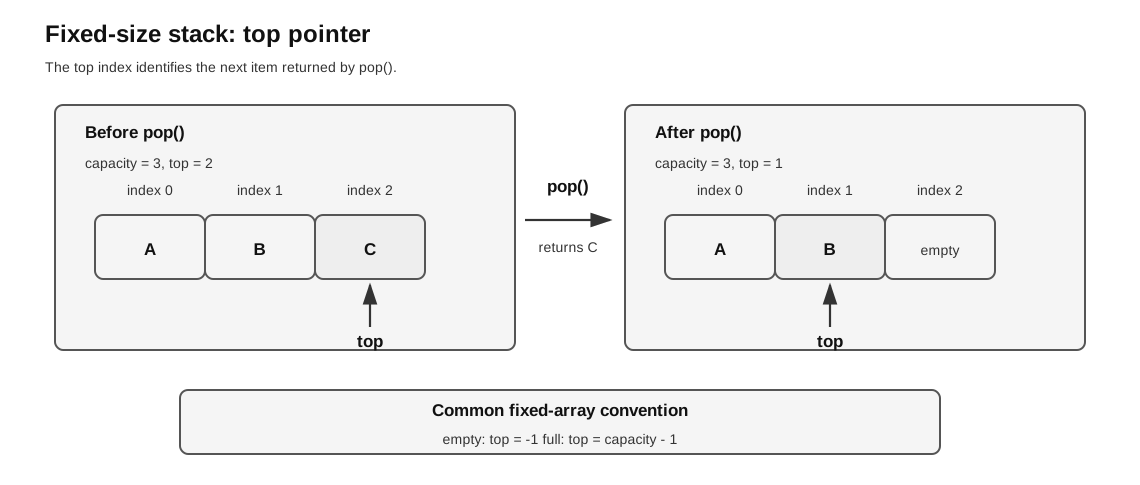
Caption: In a fixed-size array stack, top identifies the next item returned by pop(); after the pop, top moves to the previous occupied index.
Example with capacity 3:
| Step | Operation | Array state | top | Return value | Comment |
|---|---|---|---|---|---|
| 0 | start | [_, _, _] | -1 | empty | |
| 1 | push("A") | [A, _, _] | 0 | A is top | |
| 2 | push("B") | [A, B, _] | 1 | B is top | |
| 3 | push("C") | [A, B, C] | 2 | full | |
| 4 | push("D") | [A, B, C] | 2 | overflow | |
| 5 | pop() | [A, B, _] | 1 | "C" | C removed |
| 6 | pop() | [A, _, _] | 0 | "B" | B removed |
| 7 | pop() | [_, _, _] | -1 | "A" | A removed |
| 8 | pop() | [_, _, _] | -1 | underflow |
A trace table should show the array after each operation, not only the final answer.
Fixed-Size Stack Pseudocode
Push operation:
Push(item):
    IF top = capacity - 1 THEN
        OUTPUT "Stack overflow"
    ELSE
        top <- top + 1
        stack[top] <- item
    ENDIF
Pop operation:
Pop():
    IF top = -1 THEN
        OUTPUT "Stack underflow"
    ELSE
        item <- stack[top]
        stack[top] <- empty
        top <- top - 1
        RETURN item
    ENDIF
The check must happen before the structure is changed.
Stack Trace Checklist
When tracing a stack, record:
- the current stack contents;
- which side is the top;
- the value of
topif an array implementation is used; - the value returned by
pop()orpeek(); - whether an operation would cause underflow or overflow.
Example with the top shown on the right:
| Step | Operation | Stack state | Explanation |
|---|---|---|---|
| 0 | start | [] | empty stack |
| 1 | push(4) | [4] | 4 is now top |
| 2 | push(9) | [4, 9] | 9 is now top |
| 3 | peek() | [4, 9] | returns 9 but does not remove it |
| 4 | pop() | [4] | returns and removes 9 |
Stack Boundary Cases
Underflow happens when a program tries to remove an item from an empty stack.
Overflow happens when a program tries to insert an item into a full fixed-size stack.
Safe stack code checks these cases before changing the structure.
| Case | Meaning | Safe response |
|---|---|---|
empty stack and pop() | no item can be removed | report underflow or return an error value |
empty stack and peek() | no top item exists | report underflow or return an error value |
full fixed-size stack and push() | no empty slot exists | report overflow |
A Python list can grow dynamically, so ordinary Python append() does not normally cause fixed-capacity overflow. However, syllabus questions may still ask about fixed-size array implementations.
Queue: First In, First Out
A queue follows FIFO order: first in, first out.
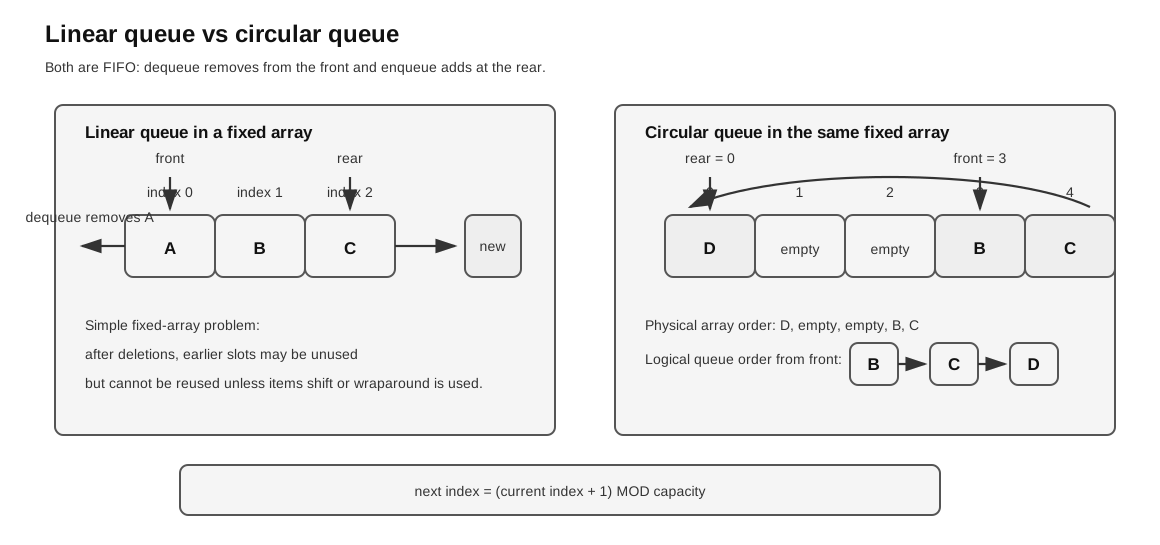
Caption: Both panels use capacity 5. Trace the linear queue from front = 2 to rear = 4; then trace the circular queue from front = 2 for five modulo steps. The physical circular row F, G, C, D, E represents logical FIFO order C, D, E, F, G.
Example trace:
| Operation | Queue after operation | Return value |
|---|---|---|
| start | [] | |
enqueue("A") | ["A"] | |
enqueue("B") | ["A", "B"] | |
enqueue("C") | ["A", "B", "C"] | |
dequeue() | ["B", "C"] | "A" |
The invariant is that the front item is always the next item to be removed.
For a queue:
enqueue()adds at the rear;dequeue()removes from the front;peek()returns the front item without removing it.
Simple Python Queue and Its Limitation
A simple Python list can model a queue like this:
queue = []

queue.append("A")      # enqueue
queue.append("B")      # enqueue
removed = queue.pop(0) # dequeue
This is easy to understand, but pop(0) is inefficient for long lists because all later items have to shift left. For syllabus tracing, it is more important to understand front and rear pointers than to rely on pop(0).
Linear Queue
In an array-based linear queue, two positions are tracked:
front: index of the item to remove next;rear: index where the most recent item was added, or where the next item will be added depending on the convention.
This note uses the convention that rear is the index of the most recently added item.
The key trace idea is to record the array, front, and rear after every operation.
Problem with a simple linear queue:
- after several dequeues, earlier array slots become unused;
- if
rearhas reached the end of the array, the queue may appear full even though there are empty slots at the front.
Trace example:
| Step | Operation | Array state | front | rear | Return value |
|---|---|---|---|---|---|
| 0 | start | [_, _, _] | - | - | |
| 1 | enqueue A | [A, _, _] | 0 | 0 | |
| 2 | enqueue B | [A, B, _] | 0 | 1 | |
| 3 | dequeue | [_, B, _] | 1 | 1 | A |
| 4 | enqueue C | [_, B, C] | 1 | 2 |
At step 4, index 0 is empty but a simple linear queue cannot use it unless items are shifted or a circular queue is used.
Linear Queue Pseudocode
One possible fixed-size linear queue convention is:
- an empty queue has
front = -1andrear = -1; - the first enqueue sets both
frontandrearto 0; rear = capacity - 1means no more insertion is possible in a simple linear queue.
Enqueue operation:
Enqueue(item):
    IF rear = capacity - 1 THEN
        OUTPUT "Queue overflow"
    ELSE IF front = -1 THEN
        front <- 0
        rear <- 0
        queue[rear] <- item
    ELSE
        rear <- rear + 1
        queue[rear] <- item
    ENDIF
Dequeue operation:
Dequeue():
    IF front = -1 THEN
        OUTPUT "Queue underflow"
    ELSE
        item <- queue[front]
        queue[front] <- empty
        IF front = rear THEN
            front <- -1
            rear <- -1
        ELSE
            front <- front + 1
        ENDIF
        RETURN item
    ENDIF
Different textbooks may use slightly different conventions. Always follow the convention stated in the question.
Circular Queue
A circular queue treats the array as if the end connects back to the start. When a pointer moves past the last index, it wraps to index 0.
For an array of length capacity, a pointer can move using:
next_index = (current_index + 1) % capacityIn mathematical notation:
The modulo operation gives the remainder after division by capacity. This is why index 2 wraps to index 0 when the capacity is 3:
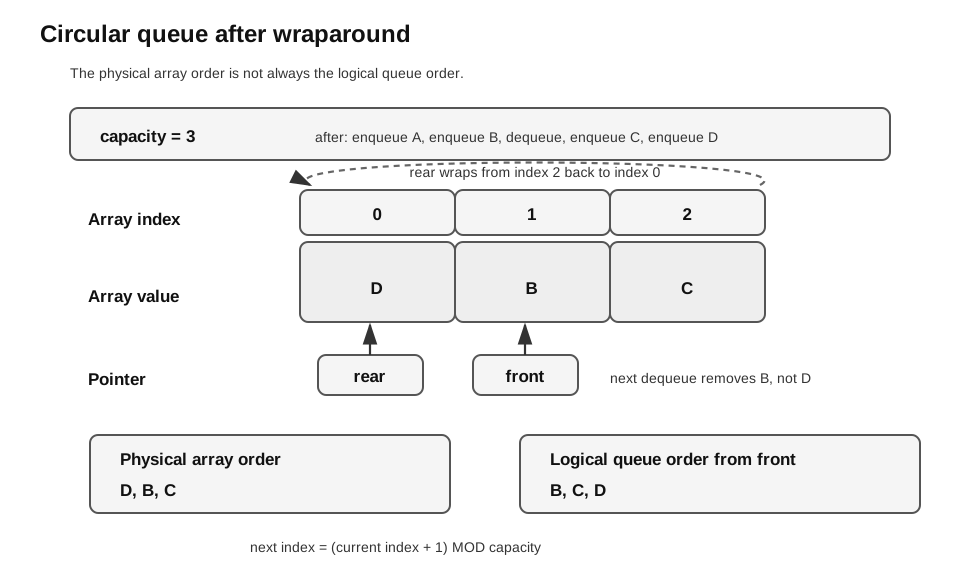
Caption: Begin at front, then take exactly the stored number of items while advancing modulo capacity. This reconstructs logical FIFO order even when the physical row wraps; the next dequeue() always removes the item at front.
Beginner trace with capacity 3:
| Step | Operation | Array state | front | rear | Stored items in queue order | Return value |
|---|---|---|---|---|---|---|
| 0 | start | [_, _, _] | - | - | empty | |
| 1 | enqueue A | [A, _, _] | 0 | 0 | A | |
| 2 | enqueue B | [A, B, _] | 0 | 1 | A, B | |
| 3 | dequeue | [_, B, _] | 1 | 1 | B | A |
| 4 | enqueue C | [_, B, C] | 1 | 2 | B, C | |
| 5 | enqueue D | [D, B, C] | 1 | 0 | B, C, D |
At step 5, rear wraps from index 2 to index 0. The physical array order is [D, B, C], but the queue order is still B, C, D because front = 1.
This is a common beginner trap: array order is not always the same as queue order.
Distinguishing Full and Empty in a Circular Queue
In a circular queue, front == rear can be ambiguous if no extra information is stored.
For example, depending on the implementation, front == rear could mean:
- the queue has one item;
- the queue is empty;
- the queue is full.
To avoid ambiguity, many circular queue implementations use one of these designs:
| Design | How it distinguishes full and empty |
|---|---|
store size | empty when size = 0; full when size = capacity |
| leave one slot unused | empty when front catches rear; full when the next rear position would catch front |
This note uses the size design in the Python model below because it is easier for beginners to trace.
Circular Queue Python Model
class CircularQueue:
    def __init__(self, capacity):
        if capacity <= 0:
            raise ValueError("capacity must be positive")
        self.items = [None] * capacity
        self.front = 0
        self.size = 0

    def is_empty(self):
        return self.size == 0

    def is_full(self):
        return self.size == len(self.items)

    def enqueue(self, value):
        if self.is_full():
            raise IndexError("queue is full")
        rear = (self.front + self.size) % len(self.items)
        self.items[rear] = value
        self.size = self.size + 1

    def dequeue(self):
        if self.is_empty():
            raise IndexError("queue is empty")
        value = self.items[self.front]
        self.items[self.front] = None
        self.front = (self.front + 1) % len(self.items)
        self.size = self.size - 1
        return value
This model stores front and size. It calculates the rear position only when adding a new item. Other correct implementations may store both front and rear.
Operation Contracts and Structural Invariants
An implementation may raise an exception, return a sentinel, or report an error for underflow/overflow, but its contract must say which. An invalid operation must leave the structure unchanged.
- fixed stack:
top = -1exactly when empty; occupied slots are0..top; - linear queue under this note’s convention: empty exactly when
front = rear = -1; occupied logical slots run fromfrontthroughrear; - circular queue with
size:0 <= size <= capacity, and logical itemkis at(front + k) MOD capacity.
For a circular queue, begin at front and take exactly size modulo steps. Do not infer FIFO order by reading physical slots left to right.
Test capacity 1, exact capacity, overflow, underflow, dequeue-to-empty, refill, and wraparound. A debugging check compares expected logical order with front/size: if front advances without size decreasing after dequeue, the first failed state is the count/occupancy invariant.
Circular Queue Pseudocode Using front and size
This version matches the Python model above.
IsEmpty():
    RETURN size = 0

IsFull():
    RETURN size = capacity
Enqueue operation:
Enqueue(item):
    IF size = capacity THEN
        OUTPUT "Queue overflow"
    ELSE
        rear <- (front + size) MOD capacity
        queue[rear] <- item
        size <- size + 1
    ENDIF
Dequeue operation:
Dequeue():
    IF size = 0 THEN
        OUTPUT "Queue underflow"
    ELSE
        item <- queue[front]
        queue[front] <- empty
        front <- (front + 1) MOD capacity
        size <- size - 1
        RETURN item
    ENDIF
The formula for calculating rear works because front + size points to the next empty position after the current queue contents, and modulo wraps that position back into the array.
Exam Trace Method for Queues
For any queue trace, especially a circular queue, record these after every operation:
- the array contents;
- the value of
front; - the value of
rear, if the implementation stores it; - the value of
size, if the implementation stores it; - the item returned by
dequeue()orpeek(); - whether the operation causes underflow or overflow.
A useful exam habit is to separate physical array order from logical queue order.
Example:
Array: [D, B, C]
front = 1
Queue order: B, C, D
The next item removed is B, not D.
Comparing Stack, Linear Queue, and Circular Queue
| Feature | Stack | Linear queue | Circular queue |
|---|---|---|---|
| Removal rule | newest item first | oldest item first | oldest item first |
| Main operation pair | push, pop | enqueue, dequeue | enqueue, dequeue |
| Important pointer/index | top | front, rear | front, rear or size |
| Empty risk | underflow | underflow | underflow |
| Full risk in fixed array | overflow | overflow when rear reaches end | overflow only when all usable slots are filled |
| Special idea | top controls access | unused front slots may appear | modulo wraparound reuses slots |
Common Mistakes
- Saying a stack removes the first item added.
- Saying a queue removes the most recent item.
- Calling queue removal
pop()without explaining that the front item is removed. - Forgetting underflow checks.
- Forgetting overflow checks in fixed-size implementations.
- Updating
top,front, orrearbefore checking whether the operation is valid. - Moving
rearin a circular queue without using modulo. - Treating the physical array order as the queue order after wraparound.
- Assuming
front == rearis enough to distinguish full and empty in every circular queue design. - Not clearing a dequeued array slot when tracing state.
Check Your Understanding
- After pushing
A,B,C, what doespop()return? - After enqueueing
A,B,C, what doesdequeue()return? - Why can a circular queue reuse an earlier array slot?
- What is underflow?
- In a fixed-size stack of capacity 4, what does
top = -1usually mean? - In a circular queue with capacity 5, what is
(4 + 1) MOD 5? - If a circular queue has array
[D, B, C]andfront = 1, which item is removed next?
Answers:
C.A.- The pointer wraps around using modulo once it passes the last index.
- Trying to remove an item from an empty structure.
- The stack is empty.
0.B, because the queue order starts atfront, not at array index 0.