Implementing Stacks and Queues
This note focuses on writing stack and queue code. For the ADT concepts, see Stacks and Queues.
You can read this note directly if you know Python classes, lists, methods, and raise. The key beginner habit is to track both the stored values and the control variables such as front, size, or the top position.
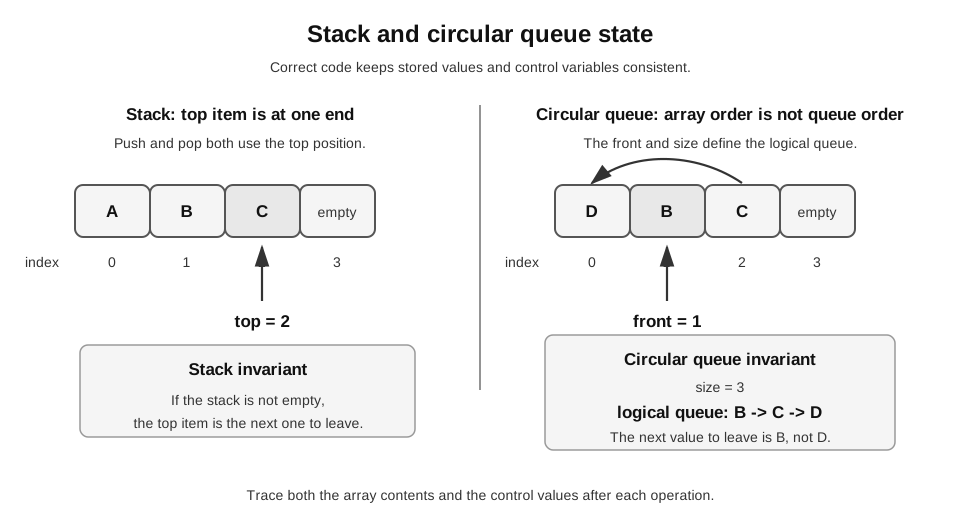
Caption: For the stack, top = 2 identifies C as the next pop. For the capacity-3 circular queue, start at front = 1 and take size = 3 modulo steps through physical [D, B, C], giving logical FIFO order B, C, D; the next dequeue returns B.
What You Are Implementing
A stack or queue is not just a list of values. It is a structure with rules about which value can be removed next.
| Structure | Removal rule | Everyday idea | Common operations |
|---|---|---|---|
| stack | last in, first out | pile of trays | push, pop, peek |
| queue | first in, first out | waiting line | enqueue, dequeue |
The code must preserve the rule after every operation. A program that stores the right values but removes the wrong value is still incorrect.
Implementation Vocabulary
| Word | Meaning in code |
|---|---|
| state | the values currently stored inside the object |
| method | a function that belongs to the object |
| underflow | trying to remove from an empty structure |
| overflow | trying to add to a full fixed-size structure |
| invariant | a rule that should remain true after every operation |
Three Levels of Thinking
When reading or writing stack and queue code, keep three levels separate.
| Level | Question to ask | Example |
|---|---|---|
| ADT idea | Which value should leave next? | A stack removes the most recently pushed value. |
| Python representation | Which attributes store the state? | self.items, self.front, self.size |
| Implementation trace | Which variable changes after this operation? | after dequeue(), front moves to the next position |
This matters because beginners often know the ADT rule but lose marks when they update the implementation state incorrectly.
Stack Using a Python List
A simple Python implementation can use the end of a list as the top of the stack.
class Stack:
    def __init__(self):
        self.items = []

    def is_empty(self):
        return len(self.items) == 0

    def push(self, value):
        self.items.append(value)

    def pop(self):
        if self.is_empty():
            raise IndexError("pop from empty stack")
        return self.items.pop()

    def peek(self):
        if self.is_empty():
            raise IndexError("peek from empty stack")
        return self.items[-1]
Why the List End Is Used as the Top
In this implementation:
bottom of stack                  top of stack
      ↓                              ↓
[    "A",          "B",            "C"    ]
The top item is self.items[-1]. Therefore:
push(value)usesappend(value)to add at the top;pop()usespop()to remove from the top;peek()returnsself.items[-1]without removing it.
Stack invariant:
If the stack is not empty, the top item is self.items[-1].Code Reading
| Line | Purpose |
|---|---|
self.items = [] | starts with an empty stack |
self.items.append(value) | places the new value on top |
if self.is_empty(): | prevents underflow |
return self.items.pop() | removes and returns the top item |
return self.items[-1] | returns the top item without changing the stack |
Stack Trace
| Operation | items | Return value | Explanation |
|---|---|---|---|
| start | [] | empty stack | |
push("A") | ["A"] | "A" is now top | |
push("B") | ["A", "B"] | "B" is now top | |
peek() | ["A", "B"] | "B" | top is returned but not removed |
pop() | ["A"] | "B" | last pushed item leaves first |
pop() | [] | "A" | stack becomes empty |
Stack Tests
stack = Stack()
assert stack.is_empty()

stack.push("A")
stack.push("B")
assert stack.peek() == "B"
assert stack.pop() == "B"
assert stack.pop() == "A"
assert stack.is_empty()
Underflow should also be tested. The following test expects an IndexError:
stack = Stack()
try:
    stack.pop()
    assert False          # this line should not run
except IndexError:
    pass                  # expected error
Linear Queue Using a Python List
A queue removes the item that has been waiting the longest.
This simple version uses:
- the front of the list as the front of the queue;
- the end of the list as the rear of the queue.
class LinearQueue:
    def __init__(self):
        self.items = []

    def is_empty(self):
        return len(self.items) == 0

    def enqueue(self, value):
        self.items.append(value)

    def dequeue(self):
        if self.is_empty():
            raise IndexError("dequeue from empty queue")
        return self.items.pop(0)
This version is easy to understand but inefficient for large queues because pop(0) shifts all later items one position left.
For syllabus tracing, a fixed-size array model is often more important than this simple Python list model.
Queue invariant:
The next item to leave is at the front of the queue.Linear Queue Trace
| Operation | items | Return value | Explanation |
|---|---|---|---|
| start | [] | empty queue | |
enqueue("A") | ["A"] | "A" is at the front and rear | |
enqueue("B") | ["A", "B"] | "B" joins at the rear | |
dequeue() | ["B"] | "A" | first item leaves first |
dequeue() | [] | "B" | queue becomes empty |
Linear Queue Tests
queue = LinearQueue()
assert queue.is_empty()

queue.enqueue("A")
queue.enqueue("B")
assert queue.dequeue() == "A"
assert queue.dequeue() == "B"
assert queue.is_empty()
Underflow test:
queue = LinearQueue()
try:
    queue.dequeue()
    assert False
except IndexError:
    pass
Fixed-Size Queue Thinking
Fixed-Array Stack Implementation
class FixedStack:
    def __init__(self, capacity):
        if capacity <= 0:
            raise ValueError("capacity must be positive")
        self.items = [None] * capacity
        self.top = -1
    def push(self, value):
        if self.top == len(self.items) - 1:
            raise IndexError("push into full stack")
        self.top += 1; self.items[self.top] = value
    def pop(self):
        if self.top == -1:
            raise IndexError("pop from empty stack")
        value = self.items[self.top]; self.items[self.top] = None; self.top -= 1
        return value
    def peek(self):
        if self.top == -1:
            raise IndexError("peek into empty stack")
        return self.items[self.top]
Invariant: top = -1 exactly when empty; occupied slots are 0..top. Test capacity 1, exact fill, LIFO pop, pop-to-empty, overflow/underflow, and unchanged state after rejection.
stack = FixedStack(1)
stack.push("A")
before = (stack.items[:], stack.top)
try:
    stack.push("B")
    assert False
except IndexError:
    assert (stack.items, stack.top) == before
assert stack.pop() == "A" and stack.top == -1
Fixed-Array Linear Queue Implementation
This model uses front = rear = -1 for empty and does not shift values. Freed slots before front are not reused until the queue empties and resets.
class FixedLinearQueue:
    def __init__(self, capacity):
        if capacity <= 0:
            raise ValueError("capacity must be positive")
        self.items = [None] * capacity
        self.front = self.rear = -1
    def enqueue(self, value):
        if self.rear == len(self.items) - 1:
            raise IndexError("enqueue into full linear queue")
        if self.front == -1:
            self.front = 0
        self.rear += 1; self.items[self.rear] = value
    def dequeue(self):
        if self.front == -1:
            raise IndexError("dequeue from empty queue")
        value = self.items[self.front]; self.items[self.front] = None
        if self.front == self.rear:
            self.front = self.rear = -1
        else:
            self.front += 1
        return value
Test empty, capacity 1, FIFO, exact fill, false-full (rear at the final index despite earlier unused slots), final-dequeue reset, refill, and unchanged state after errors. A circular queue solves false-full by wrapping.
queue = FixedLinearQueue(2)
queue.enqueue("A")
queue.enqueue("B")
assert queue.dequeue() == "A"
before = (queue.items[:], queue.front, queue.rear)
try:                         # slot 0 is free, but rear is already at the end
    queue.enqueue("C")       # a linear queue is therefore false-full
    assert False
except IndexError:
    assert (queue.items, queue.front, queue.rear) == before
assert queue.dequeue() == "B"
assert (queue.front, queue.rear) == (-1, -1)
queue.enqueue("C")           # reset makes the array reusable
assert queue.dequeue() == "C"
Some exam-style implementations use a fixed-size array. In that model, the queue has a maximum capacity.
This adds two possible error conditions:
| Situation | Meaning |
|---|---|
| underflow | trying to dequeue() from an empty queue |
| overflow | trying to enqueue() into a full queue |
A fixed-size queue must check overflow before adding a new item. Without this check, the program may overwrite existing queue values or move control variables into an invalid state.
Circular Queue
A circular queue uses a fixed-size list and wraps around when it reaches the end of the array.
The important idea is that the physical array does not move. Only the control values change.
class CircularQueue:
    def __init__(self, capacity):
        if capacity <= 0:
            raise ValueError("capacity must be positive")
        self.items = [None] * capacity
        self.front = 0
        self.size = 0

    def is_empty(self):
        return self.size == 0

    def is_full(self):
        return self.size == len(self.items)

    def enqueue(self, value):
        if self.is_full():
            raise IndexError("enqueue into full queue")
        rear = (self.front + self.size) % len(self.items)
        self.items[rear] = value
        self.size = self.size + 1

    def dequeue(self):
        if self.is_empty():
            raise IndexError("dequeue from empty queue")
        value = self.items[self.front]
        self.items[self.front] = None
        self.front = (self.front + 1) % len(self.items)
        self.size = self.size - 1
        return value
Representation
| Attribute | Meaning |
|---|---|
self.items | fixed-size array storing the queue values |
self.front | index of the next value to leave |
self.size | number of values currently in the queue |
The rear position is calculated when needed:
In Python, this is written as:
rear = (self.front + self.size) % len(self.items)The modulo operator % wraps the index back to 0 when it reaches the end of the array.
Circular Queue Invariant
capacity > 0; 0 <= size <= capacity; the logical queue contains size items, starting at front and moving right with wrap-around.This is the most important sentence in the circular queue implementation.
Test zero/negative capacity rejection, capacity 1, wraparound, drain and refill, and full/empty errors. Snapshot items, front, and size before a failed operation and assert they are unchanged afterwards.
The array display may not match the logical queue order after wrap-around.
Circular Queue Trace
| Operation | items | front | size | Logical queue |
|---|---|---|---|---|
| start | [None, None, None] | 0 | 0 | empty |
| enqueue A | ["A", None, None] | 0 | 1 | A |
| enqueue B | ["A", "B", None] | 0 | 2 | A, B |
| dequeue | [None, "B", None] | 1 | 1 | B |
| enqueue C | [None, "B", "C"] | 1 | 2 | B, C |
| enqueue D | ["D", "B", "C"] | 1 | 3 | B, C, D |
The final enqueue wraps to index 0. The physical array is:
["D", "B", "C"]but the logical queue order is:
B, C, Dbecause front = 1.
Code Reading for enqueue()
| Line | Purpose |
|---|---|
if self.is_full(): | prevents overflow |
rear = (self.front + self.size) % len(self.items) | finds the next free rear position |
self.items[rear] = value | stores the new value |
self.size = self.size + 1 | records that one more item is in the queue |
Code Reading for dequeue()
| Line | Purpose |
|---|---|
if self.is_empty(): | prevents underflow |
value = self.items[self.front] | saves the value before clearing the slot |
self.items[self.front] = None | clears the old front position |
self.front = (self.front + 1) % len(self.items) | moves the front with wrap-around |
self.size = self.size - 1 | records that one item has left |
return value | gives back the dequeued item |
Why size Is Useful
Some circular queue designs use both front and rear. In those designs, it can be tricky to tell whether the queue is empty or full.
This implementation uses size, so the checks are direct:
self.size == 0                 # empty
self.size == len(self.items)   # full
The same size value also helps calculate the next rear position.
Exam questions may instead give three control variables: front, rear, and count. In that convention, count is used for the empty and full checks, while rear usually stores the index of the most recently enqueued item. The next insertion position is then:
rear = (rear + 1) % capacityBoth designs use the same idea: modulo arithmetic keeps the array circular, and the control variables define the logical queue order.
Circular Queue Tests
queue = CircularQueue(3)
assert queue.is_empty()

queue.enqueue("A")
queue.enqueue("B")
assert queue.dequeue() == "A"

queue.enqueue("C")
queue.enqueue("D")
assert queue.is_full()

assert queue.dequeue() == "B"
assert queue.dequeue() == "C"
assert queue.dequeue() == "D"
assert queue.is_empty()
Overflow test:
queue = CircularQueue(2)
queue.enqueue("A")
queue.enqueue("B")
try:
    queue.enqueue("C")
    assert False
except IndexError:
    pass
Underflow test:
queue = CircularQueue(2)
try:
    queue.dequeue()
    assert False
except IndexError:
    pass
How to Explain This in an Exam
For stack code, explain:
The top of the stack is stored at the end of the Python list, so push appends and pop removes the last item.For queue code, explain:
A queue removes the item at the front, so enqueue adds at the rear and dequeue removes from the front.For circular queue code, explain:
The array does not rotate. The front index and size describe the logical queue order. Modulo arithmetic wraps indexes back to the start.Mini Debugging Table
| Symptom | Likely cause | Fix |
|---|---|---|
pop() crashes on an empty stack | missing underflow check | check is_empty() before removing |
peek() removes the top item | used pop() instead of indexing | return self.items[-1] |
| queue removes the newest item first | implemented stack behaviour by mistake | remove from the front, not the rear |
| queue overwrites old values | forgot overflow check | check is_full() before enqueue |
dequeue() returns the wrong item after wrap-around | confused array position with logical queue order | trace from front for size items |
| queue never becomes empty | forgot to decrease size | subtract 1 after successful dequeue() |
| enqueue skips slots | wrong rear formula | use (front + size) % capacity |
| dequeued value is lost | cleared slot before saving value | save value before setting slot to None |
Common Mistakes
- Forgetting underflow checks.
- Forgetting overflow checks in a fixed-size queue.
- Updating
frontbefore saving the dequeued value. - Calculating
rearwithout modulo. - Confusing list position with logical queue order after wrap-around.
- Thinking that a circular queue physically rotates the array.
- Forgetting to update
sizeafter enqueue or dequeue. - Testing only the normal case and not the empty or full case.
Check Your Understanding
- What does
peek()do thatpop()does not? - Why does
dequeue()savevaluebefore clearing the front slot? - In the circular queue implementation, what does
sizehelp distinguish? - If
front = 1,size = 3, and the array is["D", "B", "C"], which value leaves next? - Why does the circular queue use
% len(self.items)when moving an index? - Why is the array display not always the same as the logical queue order?
Answers:
- It returns the top item without removing it.
- The value would be lost after the slot is cleared.
- Empty and full states, and the position of the next rear slot.
"B".- It wraps the index from the end of the array back to the start.
- After wrap-around, the logical queue starts at
front, not necessarily at array index0.