Binary Trees and BST
A tree is a non-linear data structure made of nodes and edges. A binary tree is a tree in which each node has at most two children.
A binary search tree, or BST, is a special kind of binary tree that keeps values in a useful order. This order lets the program search by repeatedly choosing either the left subtree or the right subtree.
You can read this note directly without first reading the hub. The only Python ideas assumed are objects with attributes, None, comparison operators, and simple recursion. For recursion support, read Recursion and the Call Stack.
In pseudocode, <- means assignment: store the value on the right into the variable or field on the left.
What You Should Be Able to Do
By the end of this note, you should be able to:
- use binary-tree vocabulary correctly;
- distinguish a binary tree from a binary search tree;
- check whether a tree satisfies the BST rule;
- trace a search path in a BST;
- insert values into a BST one by one;
- explain why an unbalanced BST can be inefficient;
- perform pre-order, in-order, and post-order traversals;
- explain why in-order traversal of a BST gives sorted output.
Tree Vocabulary
Useful vocabulary:
| Term | Meaning |
|---|---|
| root | top node of the tree |
| parent | node with a child |
| child | node below another node |
| leaf | node with no children |
| edge | connection between a parent node and a child node |
| subtree | a smaller tree rooted at a node |
| left child | child usually drawn on the left |
| right child | child usually drawn on the right |
| empty link | a missing child link, often represented by None |
Example:
        A
       / \
      B   C
     / \
    D   E
In this tree:
Ais the root;BandCare children ofA;Ais the parent ofBandC;D,E, andCare leaves;- the subtree rooted at
BcontainsB,D, andE.
Binary Tree Versus Binary Search Tree
Every binary search tree is a binary tree, but not every binary tree is a binary search tree.
| Structure | Rule |
|---|---|
| binary tree | each node has at most two children |
| binary search tree | each node has at most two children; under this note’s duplicates-left convention, left-subtree values are <= the node and right-subtree values are > the node |
This matters because traversal works on any binary tree, but ordered search relies on the BST rule.
A binary tree can have any arrangement of values:
        10
       /  \
     30    5
This is still a binary tree because every node has at most two children. However, it is not a BST because 30 is on the left of 10, even though 30 > 10.
Binary Search Tree Rule
A binary search tree is a binary tree with an ordering rule:
- all values in the left subtree are less than or equal to the current node’s value;
- all values in the right subtree are greater than the current node’s value.
This rule must be true at every node, not only at the root.
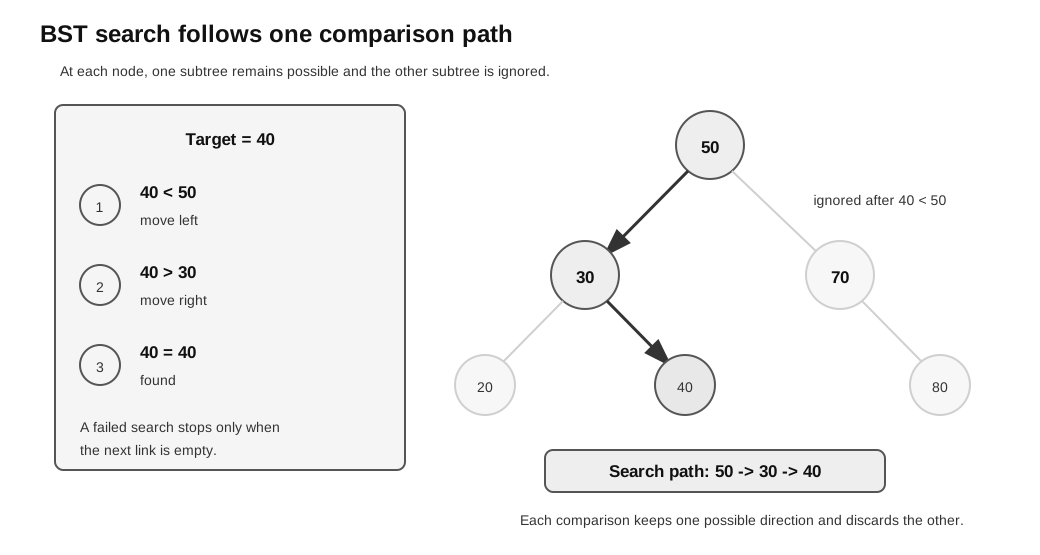
Caption: At each node, compare the target and follow exactly one child. The target, if present, must remain inside the chosen subtree; reaching an empty link proves absence under the BST invariant.
This note uses the convention that duplicate values go to the left subtree because the rule says “less than or equal to” on the left. Some exam questions may assume no duplicates. Always follow the convention given in the question.
Checking Whether a Tree Is a BST
A common beginner mistake is to check only the root and its immediate children. That is not enough. The BST rule must hold across the whole left and right subtrees.
Valid BST:
        50
       /  \
     30    70
    /  \   / \
  20   40 60  80
This is valid because:
- every value in the left subtree of
50is<= 50; - every value in the right subtree of
50is> 50; - the same rule also holds inside the subtree rooted at
30and the subtree rooted at70.
Invalid BST:
        50
       /  \
     30    70
       \
        60
At first glance, 30 is correctly placed on the left of 50. However, 60 is inside the left subtree of 50, so it must also be <= 50. Since 60 > 50, the tree is not a BST.
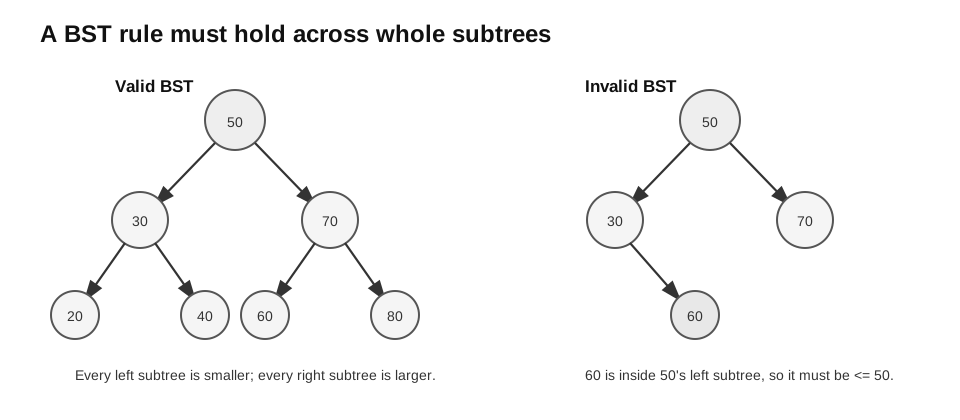
Caption: Validate inherited bounds, not only parent-child pairs. In the invalid tree, 60 is greater than its parent 30 but violates the upper bound 50 inherited from the root because it lies in 50’s left subtree.
An operational method carries an allowed interval down the tree. Start with no lower or upper bound. Moving left replaces the upper bound with the current value and permits equality under this note’s duplicates-left convention; moving right replaces the lower bound with the current value and requires a strictly greater value. A node must satisfy every inherited bound before its children are checked. This method exposes deep violations such as 60 immediately.
Beginner checklist for validating a BST:
- Start at the root.
- Check that every value in the left subtree is small enough.
- Check that every value in the right subtree is large enough.
- Repeat the same check for every subtree.
- Watch for values that satisfy the immediate-parent rule but violate an ancestor rule.
Searching a BST
Search for a target value by comparing it with the current node.
- If the target equals the current value, the search succeeds.
- If the target is smaller, move to the left child.
- If the target is larger, move to the right child.
- If the search reaches
None, the target is not present.
Pseudocode:
current <- root

WHILE current is not None
    IF target = current.data THEN
        RETURN True
    ELSE IF target < current.data THEN
        current <- current.left
    ELSE
        current <- current.right
    ENDIF
ENDWHILE

RETURN False
Trace for searching 40:
        50
       /  \
     30    70
    /  \
20 40| Current node | Comparison | Next move |
|---|---|---|
| 50 | 40 < 50 | left |
| 30 | 40 > 30 | right |
| 40 | 40 = 40 | found |
Trace for searching 35 in the same tree:
| Current node | Comparison | Next move |
|---|---|---|
| 50 | 35 < 50 | left |
| 30 | 35 > 30 | right |
| 40 | 35 < 40 | left |
None | empty link reached | not found |
The second trace is just as important as the first one. A failed search does not stop at the nearest value. It stops only when the next link to follow is empty.
Inserting into a BST
Insertion follows the same comparison path as search. When the correct empty link is found, the new node is attached there.
Example insertion order:
50, 30, 70, 20, 40Result:
        50
       /  \
     30    70
    /  \
  20    40
Insertion trace:
| Value inserted | Comparisons | Position |
|---|---|---|
| 50 | tree empty | root |
| 30 | 30 < 50 | left child of 50 |
| 70 | 70 > 50 | right child of 50 |
| 20 | 20 < 50, 20 < 30 | left child of 30 |
| 40 | 40 < 50, 40 > 30 | right child of 30 |
The same comparison rule is used for search and insertion. The difference is that search stops with found/not found, while insertion attaches a new node at the empty position.
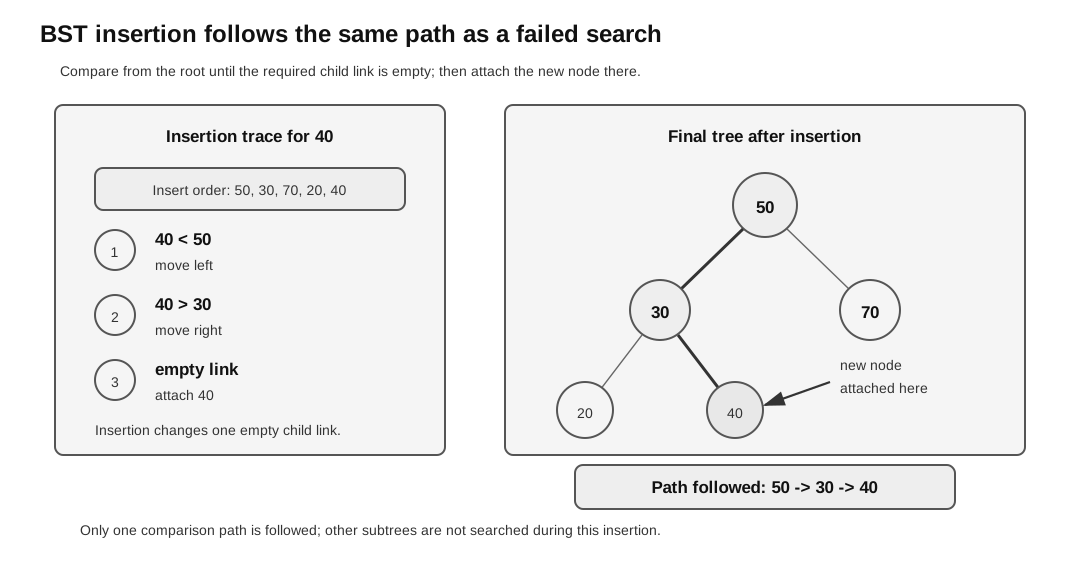
Caption: BST insertion follows one comparison path from the root until an empty child link is found; the new node is attached at that link.
Insertion Order Matters
The values in a BST are not automatically balanced. The shape depends on insertion order.
Insertion order:
5, 12, 13, 15, 42, 50can produce a skewed tree:
5
 \
  12
    \
     13
       \
        15
          \
           42
             \
              50
This tree still satisfies the BST rule, but it is inefficient because search behaves almost like a linked list.
A more balanced tree has shorter search paths:
        15
       /  \
     12    42
    /  \     \
   5   13     50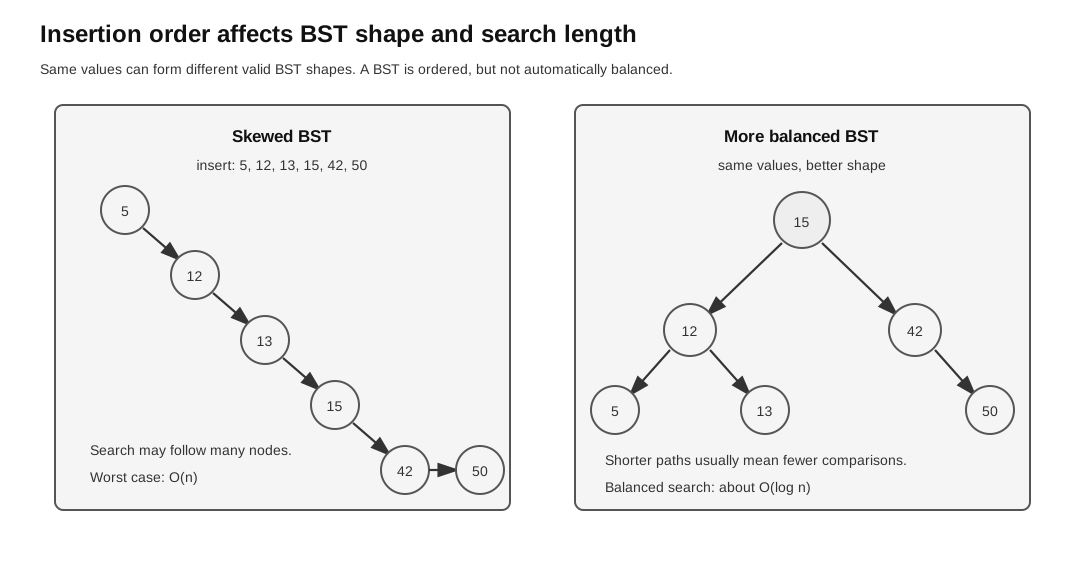
Caption: Follow the longest root-to-leaf path in each tree. Balanced branching keeps height near log n, whereas an insertion order that creates a chain can make height n-1 edges and search in the worst case.
For a balanced BST, search can take about comparisons. For a badly skewed BST, worst-case search can take comparisons. The syllabus does not require self-balancing tree algorithms, but you should understand why tree shape affects search time.
Python BST Model
class TreeNode:
    def __init__(self, data):
        self.data = data
        self.left = None
        self.right = None


def insert(root, value):
    if root is None:
        return TreeNode(value)
    if value <= root.data:
        root.left = insert(root.left, value)
    else:
        root.right = insert(root.right, value)
    return root


def search(root, target):
    current = root
    while current is not None:
        if target == current.data:
            return True
        if target < current.data:
            current = current.left
        else:
            current = current.right
    return False
This code is intentionally small. It focuses on the BST ordering rule and search path, not on advanced cases outside syllabus scope.
Tracing Recursive Insert
In the insert() function, each recursive call returns the root of the subtree after insertion. That is why the code assigns:
root.left = insert(root.left, value)or:
root.right = insert(root.right, value)For beginners, read this as: “insert the value into the smaller subtree, then reconnect that subtree to the current node.”
Example: inserting 25 into this tree:
        50
       /
     30
    /
  20
Trace:
| Call | Meaning | Return reconnects to |
|---|---|---|
insert(50, 25) | 25 < 50, insert into left subtree | 50.left |
insert(30, 25) | 25 < 30, insert into left subtree | 30.left |
insert(20, 25) | 25 > 20, insert into right subtree | 20.right |
insert(None, 25) | empty position found | new node 25 |
After insertion:
        50
       /
     30
    /
  20
    \
     25
The important idea is that recursion travels down the tree, creates the node at an empty link, then reconnects each subtree on the way back.
Array Implementation of a Binary Tree
A binary tree or BST may also be represented using arrays or a table. Instead of storing real memory addresses, the left and right pointers store array indices.
Example BST:
        15
       /  \
     12    50
    /  \   /
   5   13 42
         \
          14
One possible table representation is:
| Index | Data | Left Pointer | Right Pointer |
|---|---|---|---|
| 0 | 15 | 1 | 2 |
| 1 | 12 | 3 | 5 |
| 2 | 50 | 4 | None |
| 3 | 5 | None | None |
| 4 | 42 | None | None |
| 5 | 13 | None | 6 |
| 6 | 14 | None | None |
If root = 0, the root node is stored at index 0. The Left Pointer and Right Pointer fields tell us where to go next. None means there is no child in that direction.
In exam-style table questions, do not read the array from top to bottom and assume that this is the tree order. Always follow the pointers from the root.
Ordinary Binary-Tree Operations
A binary tree has at most two children per node but no automatic value-ordering rule. Unlike a BST, it cannot choose left or right by comparing the target with the current value, so search uses a full traversal unless the question supplies another rule.
def attach_child(parent, side, data):
    if side not in ("left", "right"):
        raise ValueError("side must be left or right")
    if getattr(parent, side) is not None:
        raise ValueError("child position is occupied")
    setattr(parent, side, TreeNode(data))

def update_node(node, new_data):
    node.data = new_data

def search_binary_tree(root, target):
    if root is None:
        return None
    if root.data == target:
        return root
    found = search_binary_tree(root.left, target)
    return found if found is not None else search_binary_tree(root.right, target)

def detach_child(parent, side):
    if side not in ("left", "right"):
        raise ValueError("side must be left or right")
    removed_subtree = getattr(parent, side)
    setattr(parent, side, None)
    return removed_subtree
TreeNode(data) creates a root or child. attach_child inserts only into an empty named position; update_node edits data; search returns the first pre-order match. detach_child uses an explicit detach-subtree deletion contract: the child and all descendants are disconnected and returned. Other questions may permit leaf-only deletion or prescribe reconnection rules, so always follow the stated contract—ordinary binary-tree deletion has no single value-ordering rule.
Test an empty tree, singleton root, occupied child position, absent target, and already-empty child link. Invalid side/attach operations above raise before changing the tree.
Tree Traversals
Traversal means visiting every node in a systematic order.
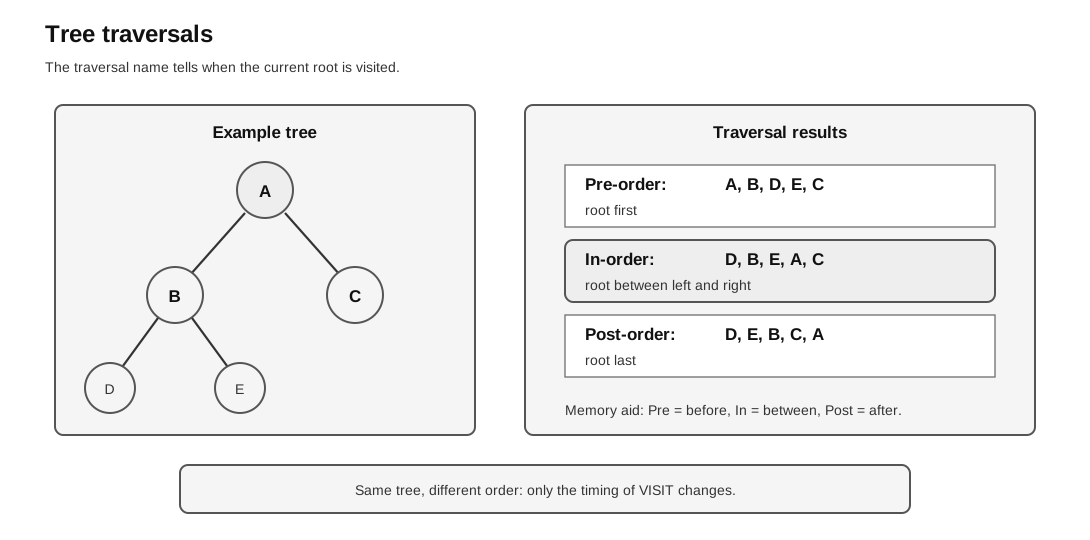
Caption: Apply the rule recursively at every subtree: write the current root before, between, or after its left/right recursive calls. Do not apply the mnemonic only once at the overall root.
For this example tree:
        A
       / \
      B   C
     / \
    D   E
The traversal orders are:
| Traversal | Rule | Result |
|---|---|---|
| pre-order | root, left, right | A, B, D, E, C |
| in-order | left, root, right | D, B, E, A, C |
| post-order | left, right, root | D, E, B, C, A |
Beginner memory aid:
- pre-order: process the root before its subtrees;
- in-order: process the root in between left and right;
- post-order: process the root after its subtrees.
Traversal pseudocode:
PreOrder(node):
    IF node is not None THEN
        VISIT node
        PreOrder(node.left)
        PreOrder(node.right)
    ENDIF

InOrder(node):
    IF node is not None THEN
        InOrder(node.left)
        VISIT node
        InOrder(node.right)
    ENDIF

PostOrder(node):
    IF node is not None THEN
        PostOrder(node.left)
        PostOrder(node.right)
        VISIT node
    ENDIF
The only difference is the position of VISIT node.
Traversal Trace Method
A good way to avoid mistakes is to ask: when should I write down the current node?
| Traversal | When to write the current node |
|---|---|
| pre-order | when first reaching the node |
| in-order | after finishing the left subtree |
| post-order | after finishing both left and right subtrees |
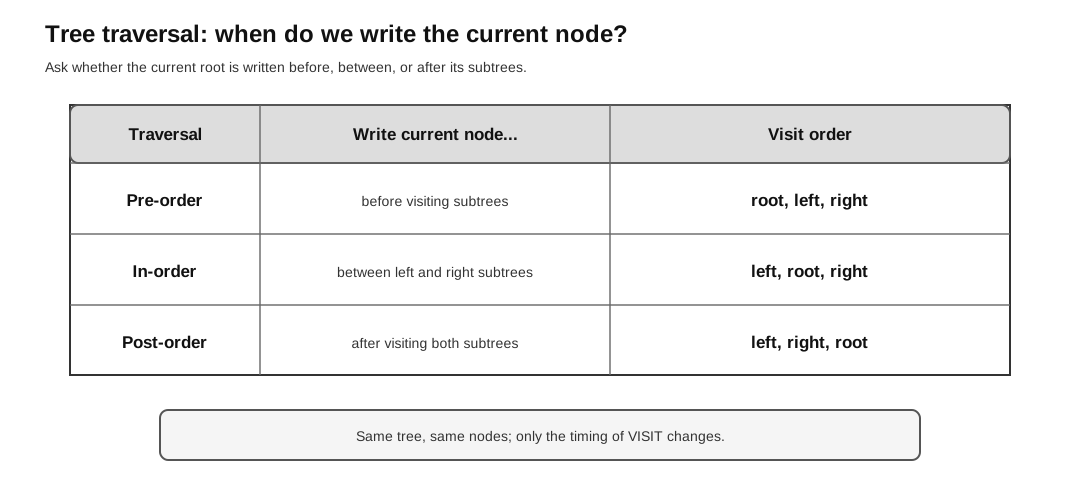
Caption: Pre-order, in-order, and post-order use the same tree and nodes; they differ only in whether the current root is written before, between, or after its subtrees.
Worked example:
        10
       /  \
      7    11
     / \     \
    6   8     20
         \   /  \
9 14 22| Traversal | Result |
|---|---|
| pre-order | 10, 7, 6, 8, 9, 11, 20, 14, 22 |
| in-order | 6, 7, 8, 9, 10, 11, 14, 20, 22 |
| post-order | 6, 9, 8, 7, 14, 22, 20, 11, 10 |
A traversal algorithm does not require the tree to be a BST. You can traverse any binary tree. However, sorted output is only guaranteed for in-order traversal when the tree is a BST.
In-Order Traversal of a BST
In-order traversal of a BST gives sorted output because:
- the left subtree contains smaller or equal values;
- the current node is visited next;
- the right subtree contains larger values.
Python:
def inorder(root):
    if root is None:
        return []
    return inorder(root.left) + [root.data] + inorder(root.right)


def preorder(root):
    if root is None:
        return []
    return [root.data] + preorder(root.left) + preorder(root.right)


def postorder(root):
    if root is None:
        return []
    return postorder(root.left) + postorder(root.right) + [root.data]
If values are inserted as 50, 30, 70, 20, 40, in-order traversal returns:
20, 30, 40, 50, 70That sorted result depends on the BST ordering rule. If the same shape is just an ordinary binary tree with unordered values, in-order traversal will still visit every node, but it will not necessarily produce sorted output.
Search, Insert, and Traversal Compared
| Task | What it does | Main trace question |
|---|---|---|
| search | follows one comparison path | Which child should I move to next? |
| insert | follows one comparison path, then attaches a node | Where is the empty link? |
| traversal | visits every node | When do I write down the current node? |
Search and insertion usually follow only one path from the root. Traversal visits the whole tree.
Exam Trace Checklist
For BST questions, record:
- the root node;
- the target or value being inserted;
- each comparison;
- whether you move left or right;
- the empty link where search fails or insertion happens;
- the traversal rule if every node must be visited.
For traversal questions, do not rely on intuition. Use the exact order:
pre-order:  root, left, right
in-order:   left, root, right
post-order: left, right, root
Syllabus Boundary
Core:
- binary tree concepts;
- BST search and insertion;
- pre-order, in-order, and post-order traversals;
- in-order traversal as sorted output for a BST;
- basic table or pointer representation of binary trees and BSTs.
- create, search, insert, edit, and delete operations for an ordinary binary tree under a stated positional contract.
Excluded as core:
- edit and deletion of nodes from a BST;
- self-balancing tree algorithms.
Deletion and self-balancing may appear as enrichment in some textbooks, but they are not needed as core algorithms here.
Common Mistakes
- Assuming every binary tree is a BST.
- Checking only the root rule and forgetting that the BST rule must hold at every node.
- Forgetting that a value in a subtree must also obey ancestor constraints.
- Reversing left and right in the search path.
- Stopping a failed search too early, before reaching an empty link.
- Assuming insertion order does not affect tree shape.
- Visiting the root too early in in-order traversal.
- Assuming in-order traversal always gives sorted output for any binary tree.
- Reading an array-based tree table from top to bottom instead of following pointers.
- Treating BST deletion as required core content.
Check Your Understanding
- What is the maximum number of children a binary tree node can have?
- Why is every BST a binary tree, but not every binary tree is a BST?
- In this note’s convention, where should a duplicate value go in a BST?
- What does it mean if BST search reaches
None? - Which traversal gives sorted output for a BST?
- Why can a skewed BST search take time?
- For pre-order traversal, when is the root visited?
- In an array-based tree table, what do the left and right pointer fields store?
Answers:
- Two.
- A BST has the binary-tree shape rule plus an ordering rule. A binary tree only needs each node to have at most two children.
- Into the left subtree, because this note uses
<=on the left and>on the right. - The target is not present in the tree.
- In-order traversal.
- If height counts edges on the longest root-to-leaf path, a skewed BST with nodes has height , so search may follow almost every node. Some questions count levels/nodes instead; state or follow the given convention.
- Before the left and right subtrees.
- They store the indices of the left and right child nodes, or an empty marker such as
Noneor-1.