Inheritance and Polymorphism
You can read this note directly if you understand classes, objects, attributes, and methods.
Inheritance and polymorphism solve two related design problems:
- Inheritance avoids repeating features shared by related classes.
- Polymorphism lets general code use the same method call with objects of different related classes.
Inheritance
Inheritance allows a subclass to reuse class behaviour from a superclass and specialise it. Instance attributes are established on each object by initialiser code; they are not pre-existing values copied automatically from a superclass object.
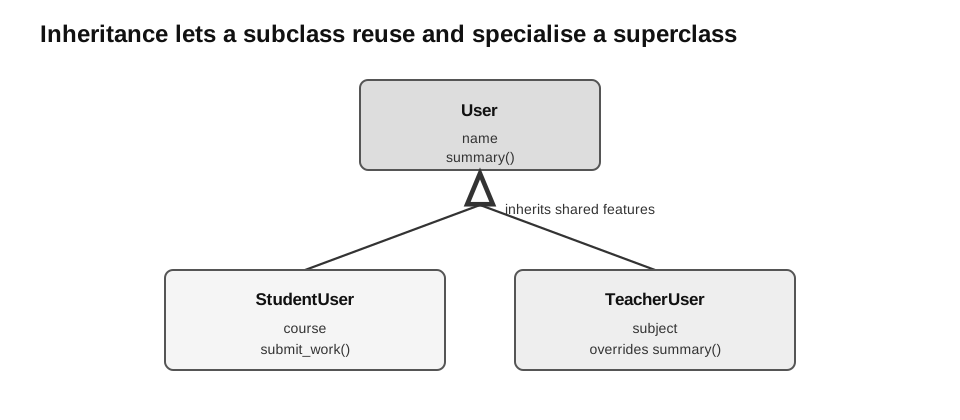
Caption: The hollow triangle points to the superclass User. Each subclass inherits class behaviour and adds specialised behaviour; super().__init__() runs the superclass initialiser on the same subclass object to establish common name state.
Suppose a system has several kinds of users. Every user has a name, but different user types need additional data and behaviour. Instead of repeating the shared code, place it in a general superclass.
class User:
    def __init__(self, name):
        self.name = name

    def summary(self):
        return self.name


class StudentUser(User):
    def __init__(self, name, course):
        super().__init__(name)
        self.course = course

    def submit_work(self):
        return f"{self.name} submitted work for {self.course}"
The declaration
class StudentUser(User):
    ...
means that StudentUser is derived from User.
A StudentUser object therefore has:
- the inherited
summary()method; - a
nameinstance attribute established by the explicitsuper().__init__(name)call; - its own
courseattribute; - its own
submit_work()method.
Tracing subclass initialisation
student = StudentUser("Aisha", "Computing")| Step | Code being executed | Effect |
|---|---|---|
| 1 | StudentUser("Aisha", "Computing") | creates a new StudentUser object |
| 2 | StudentUser.__init__(...) | starts initialising the subclass object |
| 3 | super().__init__(name) | calls User.__init__() to store the inherited name state |
| 4 | self.course = course | stores the subclass-specific course state |
After initialisation, student contains both inherited state and subclass-specific state.
When a subclass defines its own __init__(), Python does not automatically run the superclass __init__(). super() explicitly reuses that initialiser on the same object; it does not create a separate superclass object.
| Feature | How it becomes available on student |
|---|---|
summary() | inherited method lookup from User |
name | assigned by User.__init__() after the explicit super() call |
course | assigned by StudentUser.__init__() |
If the subclass omits super().__init__(name), course may exist while name is unset, and the inherited summary() will raise AttributeError. This is an initialisation defect, not evidence that inheritance failed.
Superclass and Subclass
| Term | Meaning |
|---|---|
| superclass | a more general class that provides features for subclasses |
| subclass | a more specialised class that inherits from a superclass |
A subclass object can use inherited methods unless the subclass replaces them.
assert student.summary() == "Aisha"
assert student.submit_work() == "Aisha submitted work for Computing"
Here, Python uses the inherited User.summary() method because StudentUser has not defined its own summary().
The Is-A Relationship
Inheritance should model a sensible is-a relationship:
A StudentUser is a User.
A TeacherUser is a User.
An inheritance relationship should represent specialisation, not merely a convenient way to reuse a few lines of code.
For example, a Course is not a User, so making Course inherit from User would be poor modelling even if both classes happened to store a name.
Software Reuse
Inheritance promotes software reuse because shared code is written once in the superclass and reused by subclasses.
Benefits include:
- less duplicated code;
- more consistent behaviour across related classes;
- easier maintenance, because a shared change can often be made in one place;
- improved reliability when tested superclass code is reused.
However, a change to a superclass can affect all subclasses, so the class hierarchy should still be designed carefully.
Method Overriding
A subclass can define its own version of an inherited method.
class TeacherUser(User):
    def __init__(self, name, subject):
        super().__init__(name)
        self.subject = subject

    def summary(self):
        return f"{self.name} teaches {self.subject}"
TeacherUser inherits from User, but its own summary() method replaces the inherited version for TeacherUser objects.
teacher = TeacherUser("Mr Tan", "Mathematics")
assert teacher.summary() == "Mr Tan teaches Mathematics"
Output:
Mr Tan teaches MathematicsThis is method overriding. A useful override preserves the public operation’s compatible call signature and return/behaviour contract while specialising its implementation; otherwise general polymorphic code may break.
| Idea | Meaning | Syllabus status |
|---|---|---|
| method overriding | a subclass defines its own implementation of an inherited method | core |
| method overloading | methods share a name but use different parameter lists | excluded |
For H2 Computing, focus on method overriding. Method overloading is outside the core scope.
Calling an Overridden Superclass Method
Sometimes a subclass wants to extend the superclass behaviour rather than replace it completely.
class StudentUser(User):
    def __init__(self, name, course):
        super().__init__(name)
        self.course = course

    def summary(self):
        basic = super().summary()
        return f"{basic} studies {self.course}"
Here, super().summary() calls the superclass implementation, and the subclass then adds more detail.
Polymorphism
Polymorphism means that the same method call can produce behaviour appropriate to the actual object.
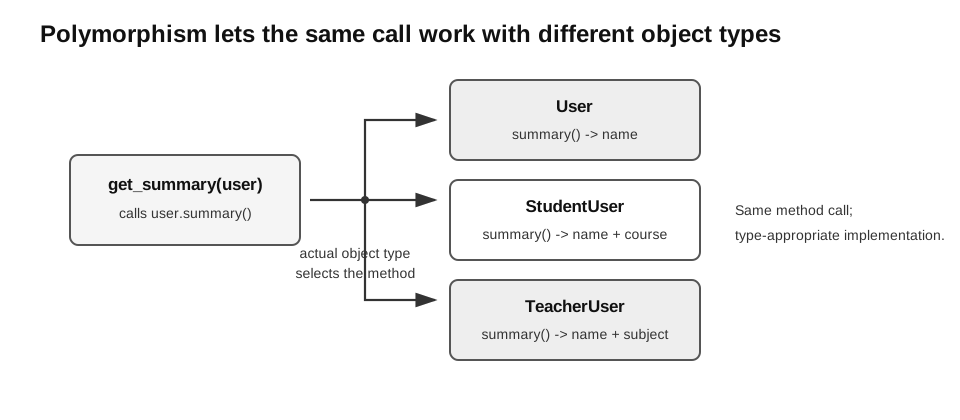
Caption: General code makes the identical user.summary() call. Runtime dispatch checks the actual object type and selects the inherited or overridden implementation, each of which returns the promised summary text.
Consider:
def get_summary(user):
    if not callable(getattr(user, "summary", None)):
        raise TypeError("object must provide a summary() method")
    return user.summary()
The function does not contain separate branches for every class. It simply asks the object to perform summary().
users = [
    User("Alex"),
    StudentUser("Aisha", "Computing"),
    TeacherUser("Mr Tan", "Mathematics"),
]

assert [get_summary(user) for user in users] == [
    "Alex",
    "Aisha studies Computing",
    "Mr Tan teaches Mathematics",
]

try:
    get_summary(object())
    assert False
except TypeError:
    pass
Assuming StudentUser uses the overridden summary() shown above, the calls are resolved as follows:
| Actual object type | Method used | Result |
|---|---|---|
User | User.summary() | "Alex" |
StudentUser | StudentUser.summary() | "Aisha studies Computing" |
TeacherUser | TeacherUser.summary() | "Mr Tan teaches Mathematics" |
The expression user.summary() is the same each time, but Python selects the method belonging to the actual object.
This is the key connection:
same method call + different object types → type-appropriate behaviourPolymorphism and Code Generalisation
Without polymorphism, a programmer might write separate functions for each exact class.
def get_student_summary(student):
    ...

def get_teacher_summary(teacher):
    ...
With polymorphism, one general function can work with all supported object types:
def get_summary(user):
    return user.summary()
This is code generalisation. The code depends on the shared method interface rather than on each object’s internal attributes.
The objects do not need identical attributes. A StudentUser may have course, while a TeacherUser has subject. The general function requires a callable summary() that satisfies the promised return/meaning contract. Python can apply this method-interface idea even beyond one inheritance hierarchy, but the syllabus example uses related subclasses.
Keep the concepts separate:
overriding = a subclass supplies a specialised implementation
polymorphism = general calling code uses one interface and runtime dispatch chooses the implementation
Paper 1 and Paper 2 Emphasis
Paper 1-style explanation
Be ready to explain:
- how inheritance promotes software reuse;
- the difference between a superclass and a subclass;
- what method overriding means;
- how polymorphism supports code generalisation.
A strong explanation links the concept to its consequence. For example:
Polymorphism allows one general section of code to call the same method on objects of different classes. Each object uses the appropriate implementation, so separate code for every class is not required.
Paper 2-style coding
Be ready to:
- declare a subclass using
class Subclass(Superclass):; - call a superclass method or initialiser using
super(); - add subclass-specific attributes;
- override a method;
- trace which method is called for each object.
Syllabus Boundary
Core:
- inheritance;
- superclass and subclass relationships;
- software reuse;
- method overriding;
- polymorphism;
- code generalisation;
- use of
super()in simple Python class hierarchies.
Excluded:
- method overloading;
- multiple inheritance.
Multiple inheritance means inheriting from more than one superclass. It is not required H2 Computing 9569 content.
Common Mistakes
- Saying that inheritance means copying and pasting code.
- Reversing the superclass and subclass relationship.
- Using inheritance when there is no sensible is-a relationship.
- Repeating superclass initialisation instead of using
super()where appropriate. - Assuming
super().__init__(...)automatically initialises subclass-specific attributes. - Confusing method overriding with method overloading.
- Thinking polymorphism requires all classes to have identical attributes.
- Looking only at the variable name rather than the actual object type when deciding which overridden method runs.
Check Your Understanding
- What is the difference between a superclass and a subclass?
- Why is
super().__init__(name)used in a subclass initialiser? - What does method overriding mean?
- Why does polymorphism support code generalisation?
- Which method runs when an object calls a method that its subclass has overridden?
Answers:
- A superclass is a general class that provides inherited features; a subclass is a specialised class derived from it.
- It reuses the superclass initialisation code to set up inherited state.
- A subclass defines its own implementation of an inherited method.
- One general section of code can use the same method call with different object types.
- The subclass version runs for an object of that subclass.