Relational Model, ER Diagrams, and Normalisation
You can read this note directly if you know what a table is. The main idea is that a relational database stores related facts in tables and uses keys to connect them.
This note answers three beginner questions:
- How should we separate facts into suitable tables?
- How do keys identify records and connect tables?
- How do ER diagrams and normalisation help us design a better database?
The Beginner Problem Relational Design Solves
A spreadsheet can store data, but it does not automatically show which facts belong together.
Example fact types:
| Fact | Better home |
|---|---|
| Aisha is a student | Student table |
| class 24S01 has tutor Ms Lim | Class table |
| Aisha borrowed Data Trails | Loan table |
Relational design asks: what are the separate entities, and how are they connected?
A weak design stores many different kinds of facts in one table. A better relational design stores each kind of fact in a suitable table, then uses keys to reconnect the facts when needed.
Table, Record, Field, Attribute
| Term | Beginner meaning |
|---|---|
| table | a grid of related data |
| record | one row in the table |
| field | one column in the table |
| attribute | a property represented by a field |
Example Student table:
| student_id | name | class_id |
|---|---|---|
| 101 | Aisha | 24S01 |
| 102 | Bo | 24S02 |
student_id, name, and class_id are fields. The first row is one record. The attribute name describes a property of each student.
A table is not automatically a good database design. The fields in a table should describe the same kind of entity or relationship.
Entities and Relationships
An entity is a thing about which data is stored. In a school library example, possible entities include:
| Entity | Possible attributes |
|---|---|
Student | student_id, name, class_id |
Class | class_id, class_name, tutor |
Book | book_id, title, author |
Loan | loan_id, student_id, book_id, loan_date |
A relationship describes how entities are connected.
Examples:
A Class has Students.
A Student borrows Books.
A Book appears in Loans.
The Loan table is useful because borrowing is not just a property of a student or a book. It is a relationship between a student and a book at a particular time.
Keys
A key helps identify or link records.
| Key type | Meaning | Example |
|---|---|---|
| primary key | uniquely identifies one record in a table | student_id in Student |
| foreign key | references a primary key in another table | class_id in Student |
| composite key | primary key made from more than one field | (student_id, book_id) in Loan |
| candidate key | any minimal field or field combination that can uniquely identify a record | student_id or a unique school email in Student |
| secondary key | a candidate key not selected as the primary key; it still uniquely identifies a record | unique school email when student_id is the primary key |
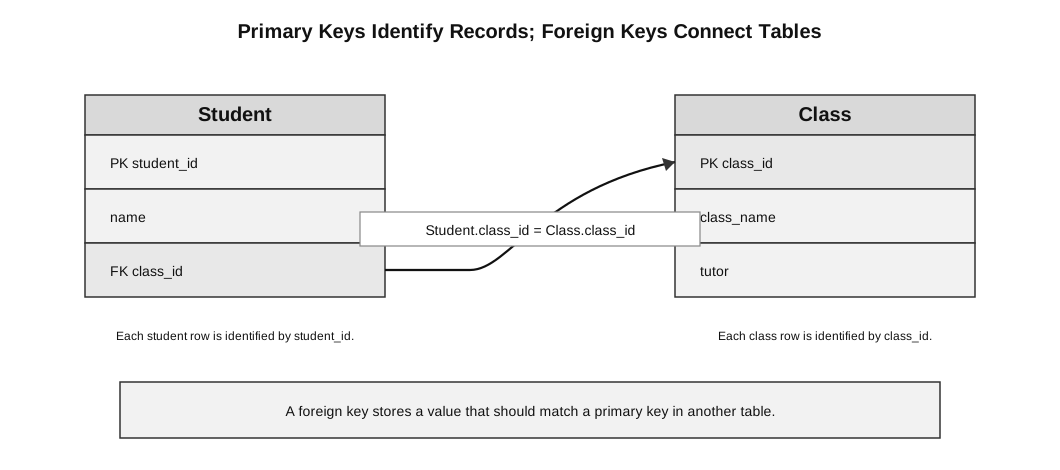
Caption: Student.class_id is a foreign key because its value should match the primary key Class.class_id.
Why not use name as a primary key? Names may repeat or change. A stable ID such as student_id is usually safer because it is designed to identify exactly one record.
Do not use secondary key here to mean any convenient search field. In this syllabus and its anchor notes, a secondary key is an alternative candidate key, so uniqueness is required. A non-unique field such as class_id may still be searched or indexed, but it is not a candidate or secondary key under this definition.
A composite key must still uniquely identify one record. For example, (student_id, book_id) only works as a loan key if the design assumes the same student cannot have multiple separate loan records for the same book. Otherwise, a separate loan_id or another identifying field would be needed.
Primary Key Versus Foreign Key
A primary key belongs to the table where it uniquely identifies a record.
A foreign key is stored in another table so that a record can refer back to the primary key.
Example:
Class(class_id, class_name, tutor)
Student(student_id, name, class_id)
Here:
Class.class_idis the primary key ofClass;Student.student_idis the primary key ofStudent;Student.class_idis a foreign key that refers toClass.class_id.
This means that a student record does not need to repeat the tutor name. It only stores the class ID, and the class ID can be used to find the class details.
What Makes a Good Primary Key?
A good primary key should be:
| Property | Meaning |
|---|---|
| unique | no two records have the same key value |
| stable | the value should not change often |
| minimal | it should not include unnecessary fields |
| non-null | every record must have a key value |
Weak choices:
| Possible key | Problem |
|---|---|
name | names may repeat or change |
phone_number | phone numbers may change or be shared |
class_id in Student | many students can be in the same class |
A designed ID such as student_id is usually safer.
Why Not One Big Table?
Suppose a flat table stores loan data:
| loan_id | student_name | class_name | tutor | book_title |
|---|---|---|---|---|
| 1 | Aisha | 24S01 | Ms Lim | Networks |
| 2 | Ben | 24S01 | Ms Lim | Databases |
The tutor Ms Lim is repeated for every student in class 24S01. This is redundancy.
Problems:
- if the tutor changes, many rows must be updated;
- if one row is missed, the database becomes inconsistent;
- if all students from a class are deleted, the class-tutor information may be lost.
These are not just storage problems. They are reliability problems.
Redundancy and Anomalies
Data redundancy means the same data is stored more than once unnecessarily.
Redundancy can lead to anomalies:
| Anomaly | Meaning | Example |
|---|---|---|
| insertion anomaly | difficult to add one fact without another unrelated fact | cannot store a new class unless a student has borrowed a book |
| update anomaly | the same fact must be edited in many places | tutor name must be changed in every matching row |
| deletion anomaly | deleting one record accidentally removes the only copy of another fact | deleting the last loan from a class removes the only record of its tutor |
A good relational design reduces these problems by storing each fact in the right place.
Data Dependency
Data dependency means one data item depends on another.
Example:
class_id -> tutorRead this as:
Once the class_id is known, the tutor can be determined.If the tutor depends on the class, then tutor should be stored with class data, not repeated inside every student or loan record.
More examples:
student_id -> student_name, class_id
book_id -> book_title, author
loan_id -> student_id, book_id, loan_date
Dependencies help us decide which fields belong together in the same table.
Normalisation to 3NF
Normalisation is a disciplined way to split data into well-designed tables.
Beginner version:
| Form | Practical question |
|---|---|
| 1NF | Are values atomic, with no repeated groups inside one field? |
| 2NF | If a table has a composite key, does every non-key field depend on the whole key? |
| 3NF | Do non-key fields depend only on the key, not on another non-key field? |
The target for H2 Computing is usually third normal form, or 3NF.
How to Think During Normalisation
Ask these questions:
- What is this table really about?
- Which field identifies one record?
- Which non-key fields depend on the key?
- Does any non-key field depend on another non-key field?
- After splitting, what foreign keys are needed to reconnect the data?
Normalisation should preserve meaning. It should not split tables randomly.
From Flat Table to 3NF: A Worked Example
Suppose the first design is one large table:
LoanRecord(loan_id, student_id, student_name, class_id, tutor, book_id, book_title, author, loan_date)A few rows may look like this:
| loan_id | student_id | student_name | class_id | tutor | book_id | book_title | author | loan_date |
|---|---|---|---|---|---|---|---|---|
| 1 | 101 | Aisha | 24S01 | Ms Lim | 501 | Networks | A Wong | 2026-07-08 |
| 2 | 102 | Ben | 24S01 | Ms Lim | 502 | Databases | M Tan | 2026-07-08 |
| 3 | 101 | Aisha | 24S01 | Ms Lim | 502 | Databases | M Tan | 2026-07-09 |
This table is understandable, but it repeats facts.
Step 1: Identify Dependencies
Look for fields that determine other fields:
student_id -> student_name, class_id
class_id -> tutor
book_id -> book_title, author
loan_id -> student_id, book_id, loan_date
This means:
| Dependency | Design implication |
|---|---|
student_id -> student_name, class_id | student facts belong in Student |
class_id -> tutor | class facts belong in Class |
book_id -> book_title, author | book facts belong in Book |
loan_id -> student_id, book_id, loan_date | loan facts belong in Loan |
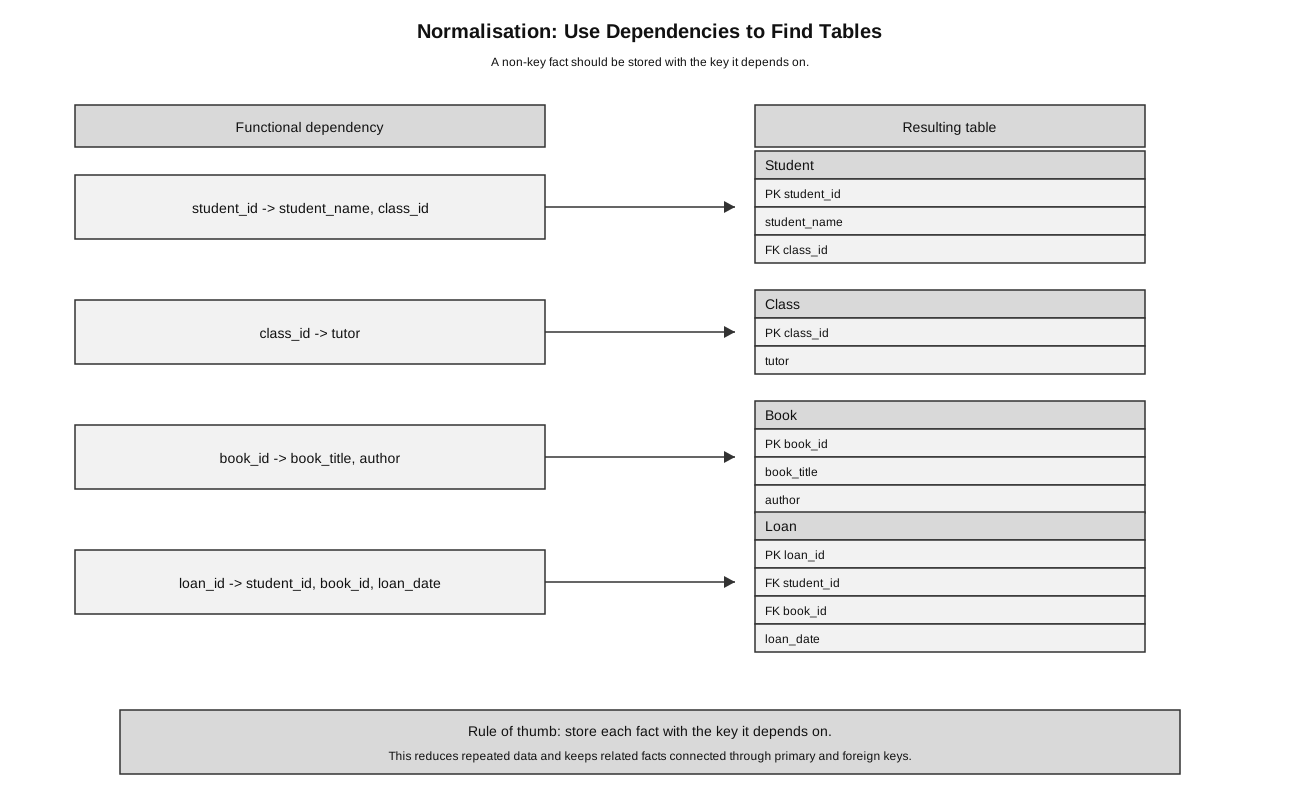
Caption: Each functional dependency points to a suitable table: store facts with the key they depend on, then reconnect tables using primary and foreign keys.
Step 2: Split Facts into Suitable Tables
A better design is:
Student(student_id, student_name, class_id)
Class(class_id, tutor)
Book(book_id, book_title, author)
Loan(loan_id, student_id, book_id, loan_date)
Here:
- student facts go in
Student; - class facts go in
Class; - book facts go in
Book; - loan facts go in
Loan.
Step 3: Keep Foreign Keys
The split tables must still be connected:
| Foreign key | Refers to | Purpose |
|---|---|---|
Student.class_id | Class.class_id | find the student’s class and tutor |
Loan.student_id | Student.student_id | find who borrowed the book |
Loan.book_id | Book.book_id | find which book was borrowed |
The data is split, but keys make it possible to reconnect it.
Step 4: Trace One Query Idea Through the Design
Question:
Which book did Aisha borrow, and on what date?Reasoning:
| Step | Table used | Reason |
|---|---|---|
| find Aisha’s student ID | Student | student_name is stored with student facts |
| find Aisha’s loan records | Loan | Loan.student_id links to Student.student_id |
| find book titles | Book | Loan.book_id links to Book.book_id |
| show dates | Loan | loan_date belongs to the borrowing event |
This is why normalised data can still be useful. The facts are separated, but SQL joins can reconnect them.
1NF, 2NF, and 3NF in Beginner Language
First Normal Form: 1NF
A table is in 1NF when each field contains atomic values and there are no repeated groups inside a single field.
Weak design:
| student_id | name | borrowed_books |
|---|---|---|
| 101 | Aisha | Networks, Databases |
Problem: borrowed_books stores multiple values in one field.
Better design:
| student_id | book_id | loan_date |
|---|---|---|
| 101 | 501 | 2026-07-08 |
| 101 | 502 | 2026-07-09 |
Each loan is a separate record.
Second Normal Form: 2NF
2NF requires the table first to be in 1NF. It matters especially when a candidate key is composite: every non-key field must depend on the whole candidate key, not just part of it. The field or fields on the left of a dependency arrow are the determinant; the fields determined by them are the dependents.
Example weak design:
Enrollment(student_id, subject_id, student_name, subject_title, enrolment_date)Assume that a student has at most one current enrolment in a subject, so (student_id, subject_id) is a candidate key:
student_namedepends only onstudent_id;subject_titledepends only onsubject_id;enrolment_datedepends on the whole composite key.
The first two are partial dependencies, so student and subject details should be moved to their own tables.
Third Normal Form: 3NF
3NF requires the table first to be in 2NF. Non-key fields must then depend on a candidate key without depending transitively through another non-key field.
Example weak design:
Student(student_id, student_name, class_id, tutor)Here:
student_id -> class_id
class_id -> tutor
So tutor depends on class_id, which is not the primary key of Student. The tutor should be stored in Class, not repeated in Student.
Better design:
Student(student_id, student_name, class_id)
Class(class_id, tutor)
ER Diagrams
An ER diagram shows entities and relationships.
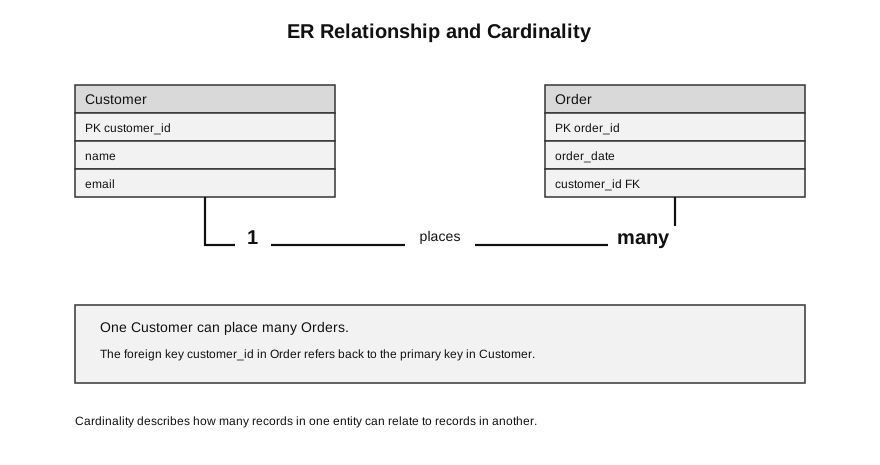
Caption: Read the relationship in both directions. In this model, one Customer may place zero or many Orders (0..*), while every Order belongs to exactly one Customer (1). A non-null foreign key in Order makes that membership compulsory; allowing it to be NULL would make the Order-to-Customer link optional.
Common relationship types:
| Relationship type | Meaning | Example |
|---|---|---|
| one-to-one | one record in A relates to one record in B | one person has one school account |
| one-to-many | one record in A relates to many records in B | one class has many students |
| many-to-many | many records in A relate to many records in B | many students can borrow many books |
Cardinality also has a minimum, called optional or mandatory participation. Recognise these endpoint meanings in crow’s-foot-style ER diagrams:
| Endpoint meaning | Range notation | Interpretation |
|---|---|---|
| exactly one | 1 | one related record is compulsory |
| zero or one | 0..1 | the relationship is optional, with at most one match |
| one or more | 1..* | at least one match is compulsory |
| zero or more | 0..* | any number of matches, including none |
The symbol nearest an entity describes how many instances of that entity may participate for one instance at the opposite end. Always read a relationship in both directions.
In textual schema diagrams, this wiki labels keys as PK and FK. Anchor ER/schema diagrams may instead use a solid underline for a primary key and a dashed underline for a foreign key; students should recognise both conventions and label their own diagrams consistently.
Example relationships:
One Class has many Students.
One Student can have many Loans.
One Book can appear in many Loans over time.
A many-to-many relationship is usually resolved using a linking table. For example, Student and Book are connected through Loan.
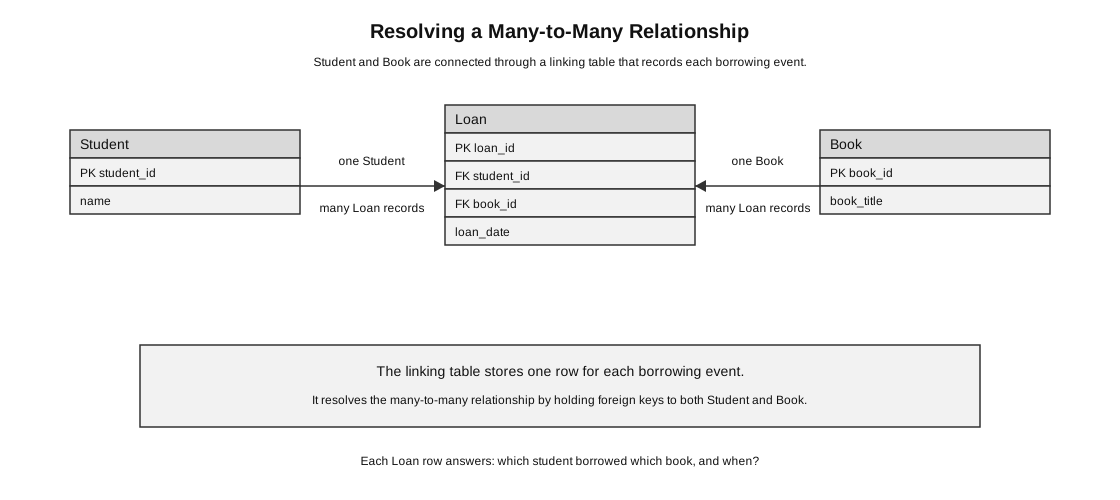
Caption: Loan resolves the many-to-many relationship by storing one borrowing event per row, with foreign keys to both Student and Book.
From ER Diagram to Tables
A simple way to move from ER thinking to table design is:
- Turn each main entity into a table.
- Choose a primary key for each table.
- Add foreign keys to represent relationships.
- Use a linking table for many-to-many relationships.
- Check whether repeated facts can cause anomalies.
Example:
| ER idea | Table design |
|---|---|
| Class has many Students | Student stores class_id as a foreign key |
| Student borrows Book | Loan links student_id and book_id |
| Book has title and author | Book stores book_title and author once |
Wrong Versus Better
| Weak statement | Better statement |
|---|---|
| A database is just many tables. | A relational database stores related facts in tables and connects them using keys. |
| A primary key is any important field. | A primary key uniquely identifies one record in a table. |
| A foreign key is a key in another table. | A foreign key is a field in one table that references the primary key of another table. |
| Normalisation means splitting tables. | Normalisation means reducing redundancy and dependency problems while preserving relationships. |
| 3NF means there is no repeated data at all. | 3NF reduces unnecessary repetition by ensuring non-key fields depend on the key, not on other non-key fields. |
How to Answer This in Exams
For a key question:
State the key type, identify the field, and explain its role.Example:
student_id is the primary key of Student because it uniquely identifies each student record.For a foreign key question:
State the field, the table it is in, the table it references, and why it is needed.Example:
Student.class_id is a foreign key that references Class.class_id. It links each student to the class record without repeating class details in every student record.For a normalisation question:
Identify repeated or dependent data, split it into suitable tables, and keep foreign keys to reconnect related records.Common Mistakes
- Choosing a field such as
nameas primary key even though names may repeat. - Storing the same tutor name in many student records.
- Splitting tables without keeping foreign keys to reconnect the data.
- Treating a many-to-many relationship as if it can be represented by one foreign key.
- Saying a table is in 3NF without checking dependencies.
- Forgetting that a linking table can represent a relationship, not just an object.
- Thinking that normalisation removes the need for joins. Normalisation often makes joins necessary.
Check Your Understanding
- What is a primary key?
- What is a foreign key?
- Why is repeated tutor data a problem?
- Why might
Loan(student_id, book_id, loan_date)use a composite key? - Why is
Student(student_id, student_name, class_id, tutor)not a good 3NF design ifclass_id -> tutor? - Why does a many-to-many relationship usually need a linking table?
Answers:
- A field or fields that uniquely identify a record in a table.
- A field that references a primary key in another table.
- It can cause inconsistent updates and unnecessary duplication.
- A loan record may be identified by the combination of student and book only if that combination is unique under the design assumptions.
- Because
tutordepends onclass_id, which is a non-key field inStudent; tutor should be stored inClass. - Because one record on each side can be related to many records on the other side. A linking table stores each specific relationship as a separate record.