Social, Economic, and AI Impacts
You can read this note directly if you understand that technology changes how people communicate, work, learn, shop, and make decisions.
This note focuses on impact reasoning. In H2 Computing, this usually means explaining how a computing system affects different people, organisations, and society.
A strong answer should usually include:
- a named issue;
- an affected stakeholder;
- a benefit;
- a risk or harm;
- a suitable safeguard;
- a balanced judgement.
Beginner Problem
Impact questions are rarely one-sided.
Example:
An online learning platform lets students watch lessons at home.Benefit:
- students can revise at their own pace.
Risk:
- students without stable internet or a quiet study space may be disadvantaged.
A good answer explains both sides and then suggests a safeguard, such as providing offline materials or school-based access.
Weak answer:
Online learning is good because students can study anywhere.Stronger answer:
Online learning can make revision more flexible because students can replay lessons
at their own pace. However, students without reliable internet, a suitable device,
or a quiet study space may be disadvantaged. The school could reduce this risk by
providing offline materials, loan devices, or school-based access.
The stronger answer is better because it names a benefit, a disadvantaged group, and a practical safeguard.
Social Impact
Social impact means the effect on people, communities, behaviour, relationships, access, trust, and well-being.
Examples:
| Technology | Possible benefit | Possible risk |
|---|---|---|
| social media | fast communication and community building | cyberbullying, misinformation, anxiety |
| online learning | flexible access to lessons | unequal access to devices or quiet study space |
| health apps | easier self-monitoring | sensitive data may be exposed |
| facial recognition | faster identity checks | surveillance, bias, loss of privacy |
| public-service chatbot | quicker responses to common questions | users may receive misleading responses or be unable to challenge decisions |
| AI proctoring | supports remote assessment | privacy concerns, false suspicion, stress |
Do not write only benefits or only harms. Strong answers discuss trade-offs.
Lifestyle and workplace: an explicit comparison
Outcome 3.4.2 asks about both settings:
| Setting | Possible benefits | Possible risks or costs |
|---|---|---|
| lifestyle | faster communication; convenient access to education, services, entertainment, and communities | privacy loss; unequal access; misinformation; attention/time displacement; cyberbullying; blurred online/offline boundaries |
| workplace | automation and productivity; remote/flexible work; new digital roles and collaboration | displacement or changing roles; employee monitoring; reskilling needs; work-life boundary erosion; unequal distribution of productivity gains |
The categories interact. Remote work changes workplace productivity and cost, but it also changes family routines, social contact, accessibility, and well-being.
Balanced social-media example
Social media may help people maintain relationships, form communities, and access information quickly. However, cyberbullying, social comparison, repeated exposure to misleading content, and displacement of sleep or offline activity may contribute to reduced well-being for some users. Avoid claiming simple causation from one platform to one mental-health outcome. Suitable responses can include reporting/moderation routes, user controls, age-appropriate design, media-literacy support, transparent recommendation settings, and monitoring for harmful outcomes.
Useful social-impact questions:
- Does the system change how people communicate or behave?
- Does it affect privacy, trust, safety, or well-being?
- Does it help some groups more than others?
- Are vulnerable or less digitally confident users affected?
- Can affected users understand, challenge, or opt out of the system?
Digital Divide
The digital divide is unequal access to technology, connectivity, or digital skills.
It can involve:
- no suitable device;
- poor internet connection;
- lack of assistive technology;
- low digital literacy;
- language or accessibility barriers;
- lack of confidence using digital forms or online services.
Example:
Moving a government service fully online may improve efficiency, but it may disadvantage people who lack devices, internet access, or confidence using digital forms.Possible safeguards include:
- keeping an offline or assisted service channel;
- providing help desks or guided support;
- making the interface accessible;
- using clear language;
- allowing trusted caregivers or staff to assist where appropriate.
Exam tip:
Do not only say "some people cannot use technology". Name the barrier:
no device, weak internet, low digital literacy, disability access, language barrier,
or lack of confidence.
Economic Impact
Economic impact means effects on jobs, income, productivity, costs, markets, and business models.
Examples:
| Impact | Explanation |
|---|---|
| productivity gain | software automates repetitive tasks |
| job displacement | some routine roles need fewer workers |
| new jobs | demand grows for data, cybersecurity, AI, and software skills |
| reskilling need | workers need training for changed roles |
| lower transaction cost | e-commerce and digital payment reduce friction |
| inequality risk | gains may benefit some groups more than others |
| platform economy | digital platforms create new ways to sell, deliver, or freelance |
| market concentration | large platforms may gain strong control over users, data, and sellers |
| implementation and maintenance cost | organisations pay for hardware, software, migration, support, cybersecurity, and training |
| software licensing/business model | subscription, proprietary, open-source, and platform models distribute cost, control, and revenue differently |
Automation is not simply “good” or “bad”. It depends on who benefits, who bears the cost, and what support is provided.
Example:
Self-checkout machines may reduce labour cost and shorten queues for some customers,
but they may reduce demand for cashier roles and make shopping harder for elderly
or disabled customers. A responsible deployment should retain staff assistance,
train workers for new roles, and monitor whether customers are excluded.
Stakeholder Analysis
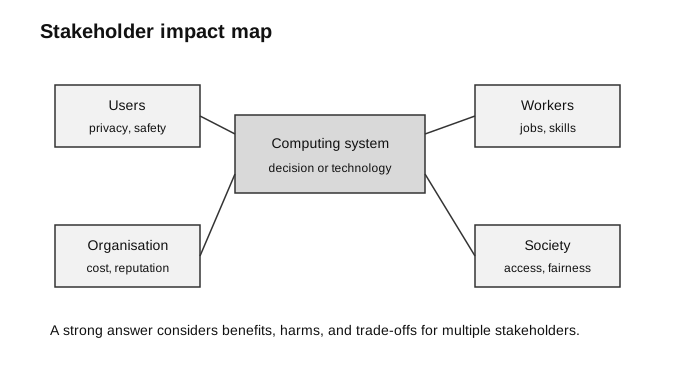
Caption: Stakeholder categories are adaptable prompts, not a complete list. Identify scenario-specific users and non-users, workers, owners/clients, regulators, communities, and vulnerable groups; then compare each group’s benefit, harm, influence, safeguard, and remaining risk.
Example: self-checkout machines in a supermarket.
| Stakeholder | Benefit | Risk |
|---|---|---|
| customers | shorter queues for some purchases | difficulty for elderly or disabled users |
| workers | fewer repetitive checkout tasks | reduced cashier roles |
| business | lower operating cost | customer frustration if system fails |
| society | productivity improvement | employment transition pressure |
When writing about stakeholders, avoid saying only “people are affected.” Name the group and the effect.
Weak:
Automation affects people.Stronger:
Cashiers may need retraining because self-checkout machines reduce the number
of routine checkout tasks, while customers may benefit from shorter queues.
Useful stakeholder groups include:
| Scenario | Possible stakeholders |
|---|---|
| school app | students, parents, teachers, school, vendor |
| health app | patients, doctors, clinic, insurer, app provider |
| AI hiring system | applicants, HR staff, company, rejected candidates |
| social media platform | users, moderators, advertisers, public, vulnerable groups |
| workplace monitoring | employees, managers, company, customers |
AI Ethics: Contemporary Application and Enrichment Boundary
High-level bias, privacy, accountability, safety, and stakeholder reasoning can be used when a question supplies an AI scenario. The detailed governance concepts and extended cases below are enrichment, matching the anchor’s boundary; they are not a separate list of core facts to reproduce in every answer.
AI systems can support prediction, classification, recommendation, generation, and automation. Their risks must be managed.
Key AI ethics issues:
| Issue | Meaning |
|---|---|
| bias | system performs unfairly for some groups |
| transparency | users may not know how a decision was made |
| accountability | unclear who is responsible for harm |
| privacy | training, input, or usage data may include sensitive information |
| safety | incorrect output may cause real harm |
| human oversight | important decisions may need human review |
| over-reliance | users may trust AI output without checking it |
| contestability | affected users may need a way to question or appeal a decision |
Example:
An AI tool shortlists job applicants.Benefits:
- faster screening;
- consistent processing of large applicant pools.
Risks:
- biased training data may disadvantage groups;
- applicants may not know why they were rejected;
- over-reliance may remove meaningful human judgement.
Safeguards:
- audit outcomes for bias;
- explain decision factors where practical;
- keep human review for high-stakes decisions;
- protect applicant data;
- monitor system performance after deployment;
- allow applicants to request review where appropriate.
Beginner checkpoint: AI risk is not only about whether the program is accurate. A system can be accurate on average but still unfair to a particular group.
AI Impact Examples
AI proctoring in school
Possible benefits:
- supports remote assessment;
- may reduce the need for physical invigilation;
- can flag suspicious behaviour for review.
Possible risks:
- students may feel constantly watched;
- false positives may unfairly suspect honest students;
- camera, microphone, or screen data may create privacy concerns;
- students with poor internet, shared rooms, disabilities, or anxiety may be disadvantaged.
Safeguards:
- tell students clearly what is recorded and why;
- collect only necessary data;
- keep human review before penalties;
- provide alternatives for students with access or disability needs;
- delete recordings when no longer needed.
AI recommendation system
Possible benefits:
- users find relevant content more quickly;
- businesses can personalise services;
- platforms can increase engagement.
Possible risks:
- users may be trapped in filter bubbles;
- misinformation may spread if engagement is rewarded over accuracy;
- vulnerable users may be shown harmful content;
- users may not know why certain content is promoted.
Safeguards:
- give users control over recommendations;
- down-rank harmful or false content;
- label sponsored or AI-recommended content clearly;
- allow users to report harmful content;
- audit the system for unintended harm.
AI chatbot for public services
Possible benefits:
- citizens can get faster answers;
- staff can focus on complex cases;
- service can be available outside office hours.
Possible risks:
- wrong answers may mislead users;
- users may not know whether advice is official or approximate;
- elderly or less digitally confident users may struggle;
- personal data typed into the chatbot may be mishandled.
Safeguards:
- make clear when users are interacting with AI;
- provide a route to human assistance;
- avoid asking for unnecessary personal data;
- log and review common errors;
- state that high-impact decisions require official confirmation.
Misinformation and Online Harm
Computing systems can spread information very quickly. This creates social, ethical, and sometimes legal concerns when false, abusive, or harmful content reaches many people.
Common issues:
| Issue | Meaning | Possible harm |
|---|---|---|
| misinformation | false or misleading information is shared | public confusion, reputational harm, unsafe decisions |
| harassment | repeated abusive, threatening, or insulting behaviour | emotional distress, fear, unsafe online environment |
| cyberbullying | online bullying, often among peers or students | stress, anxiety, social isolation |
| doxxing | publishing private information to expose or intimidate someone | privacy loss, harassment, physical safety risk |
| deepfake or manipulated media | generated or edited media presents false impression | deception, reputation damage, loss of trust |
At H2 level, the important skill is not to memorise legal sections. The important skill is to recognise the issue, identify the harm and stakeholder, and propose responsible action. Online falsehoods, harassment, doxxing, personal data, and platform policy may be relevant depending on the scenario.
Example:
A student creates a fake image of a teacher and shares it online as if it were real.Possible points:
- the teacher may suffer reputational and emotional harm;
- other students may believe false information;
- the school community may lose trust;
- the platform or school may need to remove the content and investigate;
- responsible action includes reporting the post, preserving evidence, removing harmful content, and educating students about online harm.
Exam tip:
For misinformation or harassment scenarios, do not only say "it is wrong".
Explain the harm, affected stakeholder, and suitable response.
Issue Classification
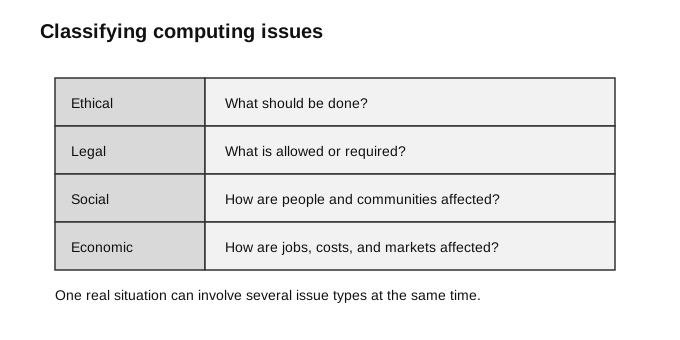
Caption: Classify the reasoning point rather than the technology. One scenario may raise ethical, legal, social, and economic points simultaneously, but each classification needs a category-specific cause and consequence.
Example: an AI surveillance camera in a workplace.
| Issue type | Possible point |
|---|---|
| ethical | employees may feel constantly monitored |
| legal | personal data and workplace monitoring rules may apply |
| social | workplace trust may decrease |
| economic | productivity may improve but morale may fall |
Worked classification:
Scenario: A company uses software to monitor employee keyboard activity.| Category | Possible point |
|---|---|
| ethical | monitoring may be excessive if employees are not properly informed |
| legal | workplace data collection and personal data rules may apply |
| social | trust between staff and management may decrease |
| economic | productivity may improve, but staff morale and retention may worsen |
This shows why one scenario can produce several valid discussion points.
Another worked classification:
Scenario: A social media platform uses AI to recommend news videos to teenagers.| Category | Possible point |
|---|---|
| ethical | the platform should avoid promoting harmful or misleading content simply to increase engagement |
| legal | online falsehoods, personal data, or harassment concerns may be relevant depending on the case |
| social | teenagers may form distorted views if they repeatedly see one-sided or false content |
| economic | the platform earns advertising revenue from engagement, which may conflict with user well-being |
Exam Answer Toolkit
Different command words require different answer depth.
| Command word | What to do | Example response style |
|---|---|---|
| identify | name the issue or stakeholder | ”One social issue is the digital divide.” |
| describe | state what the issue means in the scenario | ”Some users may lack reliable internet access.” |
| explain | give cause and consequence | ”This disadvantages them because they cannot access the service when it becomes fully online.” |
| discuss | give both benefit and risk | ”The system improves efficiency, but may exclude less digitally confident users.” |
| evaluate | reach a balanced judgement with conditions | ”It is acceptable only if offline support and data protection are provided.” |
A simple structure for longer answers:
| Step | What to include |
|---|---|
| 1. Context | What technology is being used? |
| 2. Stakeholder | Who is affected? |
| 3. Benefit | What improvement does the technology bring? |
| 4. Risk | What harm or unfairness may occur? |
| 5. Safeguard | What can reduce the risk? |
| 6. Judgement | Under what conditions is it acceptable? |
An evaluation must also explain weight. Consider:
- how likely and severe each consequence is;
- how many people are affected and whether some are especially vulnerable;
- whether harm is temporary, lasting, or reversible;
- whether benefits and harms are distributed fairly;
- whether a safeguard is effective, feasible, affordable, and itself fair;
- what residual risk remains and how outcomes will be monitored.
Link every recommendation to its mechanism:
risk → control → why it works → limitation/cost → residual risk → monitoringA judgement is stronger when it explains why the most important factors outweigh competing points, rather than ending with a generic “acceptable if safeguards are used”.
Useful phrases:
This may benefit ... because ...
However, it may disadvantage ... because ...
A suitable safeguard is ...
The organisation should ...
This is acceptable only if ...
Human review is needed when ...
Users should be informed about ...
Worked Exam-Style Answers
2-mark identification answer
Question:
A school moves all administrative forms online. Identify one possible social issue.Answer:
One social issue is the digital divide. Some parents or students may lack reliable
internet access, suitable devices, or confidence using online forms.
Why this works:
- names the issue;
- links it to the scenario.
4-mark discussion answer
Question:
A supermarket introduces self-checkout machines. Discuss one economic benefit
and one economic risk.
Answer:
One economic benefit is improved productivity, because fewer staff may be needed
for routine checkout tasks and queues may move faster. However, an economic risk
is job displacement, because cashier roles may be reduced or changed. The business
should provide retraining so affected workers can move into customer-support,
inventory, or service roles.
Why this works:
- explains benefit;
- explains risk;
- adds a safeguard.
6-mark evaluation answer
Question:
A company uses an AI system to shortlist job applicants. Evaluate whether this is
responsible.
Answer:
The system may be useful because it can process many applications quickly and apply
consistent screening criteria. That efficiency is useful, but rejection has a high impact
on an individual applicant, and a biased rule can systematically disadvantage many
members of an already vulnerable group. This makes fairness and review more decisive
than a modest saving in screening time. It may be unfair if the training data reflects
past biased hiring patterns, causing some groups of applicants to be disadvantaged.
Applicants may also not know why they were rejected, which creates a transparency
and accountability issue.

The company should audit representative outcome data across relevant groups so that
systematic disparities can be detected, protect applicant data, explain the main screening
criteria where practical, and provide trained human review and an appeal route for
borderline or high-impact decisions. Human review is not a complete solution because
reviewers may reproduce the same bias, so escalation rules and continuing outcome
monitoring are still needed. Therefore, AI shortlisting is responsible only where the
efficiency benefit is proportionate to the impact, disparities are actively corrected,
and residual errors can be reviewed and appealed; otherwise human-led screening should
take priority.
Why this works:
- gives benefit;
- gives multiple risks;
- gives safeguards;
- weighs efficiency against the scale and severity of unfair exclusion;
- explains how the safeguards work and why human review is limited;
- states residual monitoring and reaches a scenario-specific judgement.
Common Mistakes
- Assuming all automation causes unemployment in the same way.
- Ignoring reskilling and new job creation.
- Saying AI is neutral because it is a machine.
- Discussing privacy but forgetting fairness or accountability.
- Treating “more efficient” as automatically better for everyone.
- Forgetting vulnerable or less digitally confident users.
- Saying “people are affected” without naming the stakeholder group.
- Giving a safeguard that is too vague, such as “make it secure”, without saying how.
- Naming a law without linking it to the facts of the scenario.
- Writing only personal opinion instead of explaining benefit, risk, and condition.
Check Your Understanding
- What is the digital divide?
- Give one economic benefit and one economic risk of automation.
- Why can AI systems be biased?
- Why is stakeholder analysis useful?
- Why can misinformation be a social harm?
- Give one safeguard for AI use in high-impact decisions.
Answers:
- Unequal access to digital technology, connectivity, or skills.
- Benefit: improved productivity. Risk: displacement of some routine jobs.
- Training data, design choices, or deployment context may favour some groups over others.
- It helps identify benefits and harms for different affected groups.
- It may mislead people, damage reputation, reduce trust, or cause unsafe decisions.
- Keep human review, audit for bias, explain decision factors where practical, and allow review or appeal where appropriate.